Pentan-2-one and pentan-3-one can be distinguished by:
Answer & explanation
Correct answer: option 1
The correct answer is Option (1) → Iodoform test
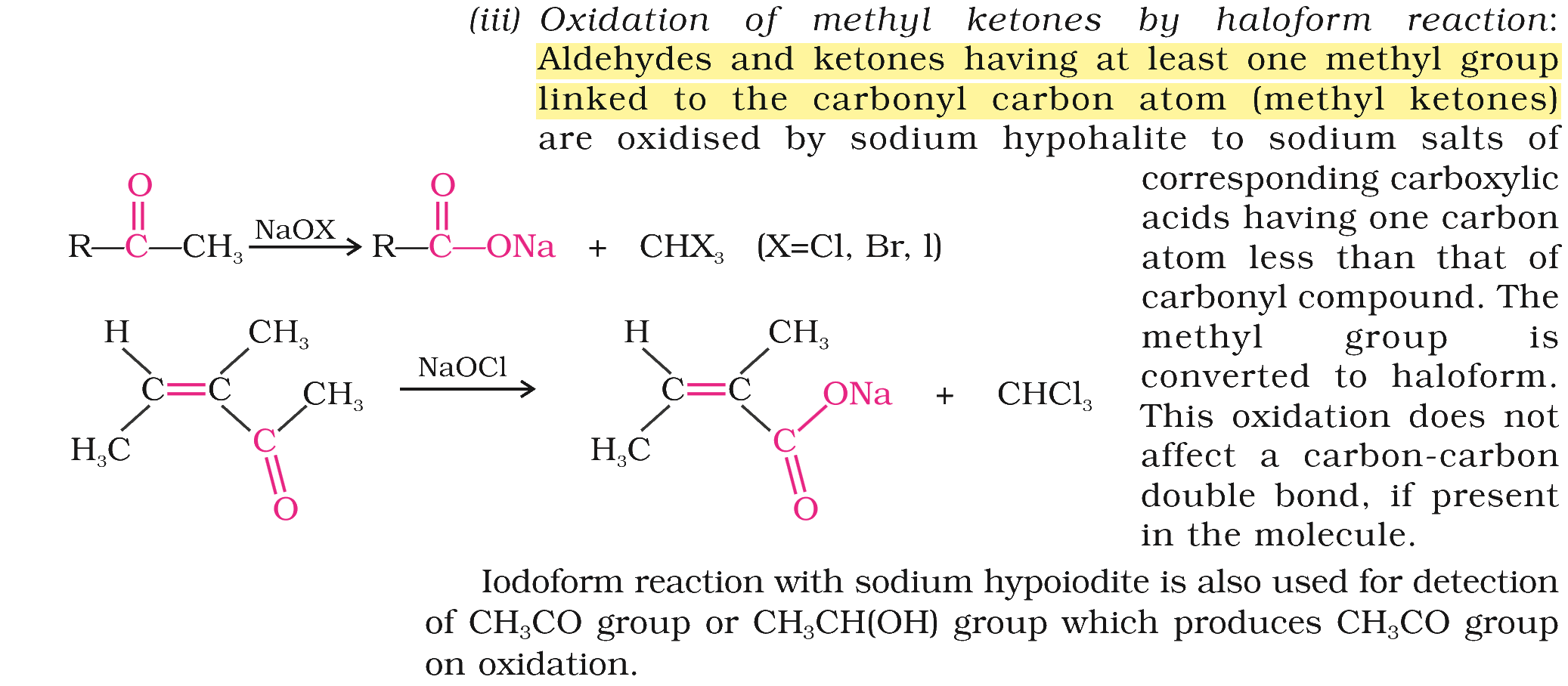
The iodoform test is given by aldehydes and ketones that have a CH3–CO– group (methyl ketones, and ethanal). With iodine and sodium hydroxide (sodium hypoiodite) the methyl group is converted into a yellow precipitate of iodoform, \( \ce{CHI3} \).
Pentan-2-one, \( \ce{CH3COCH2CH2CH3} \), is a methyl ketone and gives a yellow precipitate:
\( \ce{CH3COCH2CH2CH3 + 3I2 + 4NaOH -> CHI3 v + CH3CH2CH2COONa + 3NaI + 3H2O} \)
Pentan-3-one, \( \ce{CH3CH2COCH2CH3} \), has an ethyl group on each side of C=O and no \( \ce{CH3CO} \)– group, so it gives no precipitate.
Why the other options are incorrect
Option (2) Neutral FeCl3 test — Incorrect. It detects phenols (violet colour); neither ketone has a phenolic –OH.
Option (3) Blue litmus test — Incorrect. It detects acids (blue turns red); both ketones are neutral.
Option (4) Lucas reagent test — Incorrect. Conc. HCl + \( \ce{ZnCl2} \) distinguishes primary, secondary and tertiary alcohols; ketones do not react with it.
NCERT (2026-27 edition):
Oxidation of Methyl Ketones by Haloform Reaction