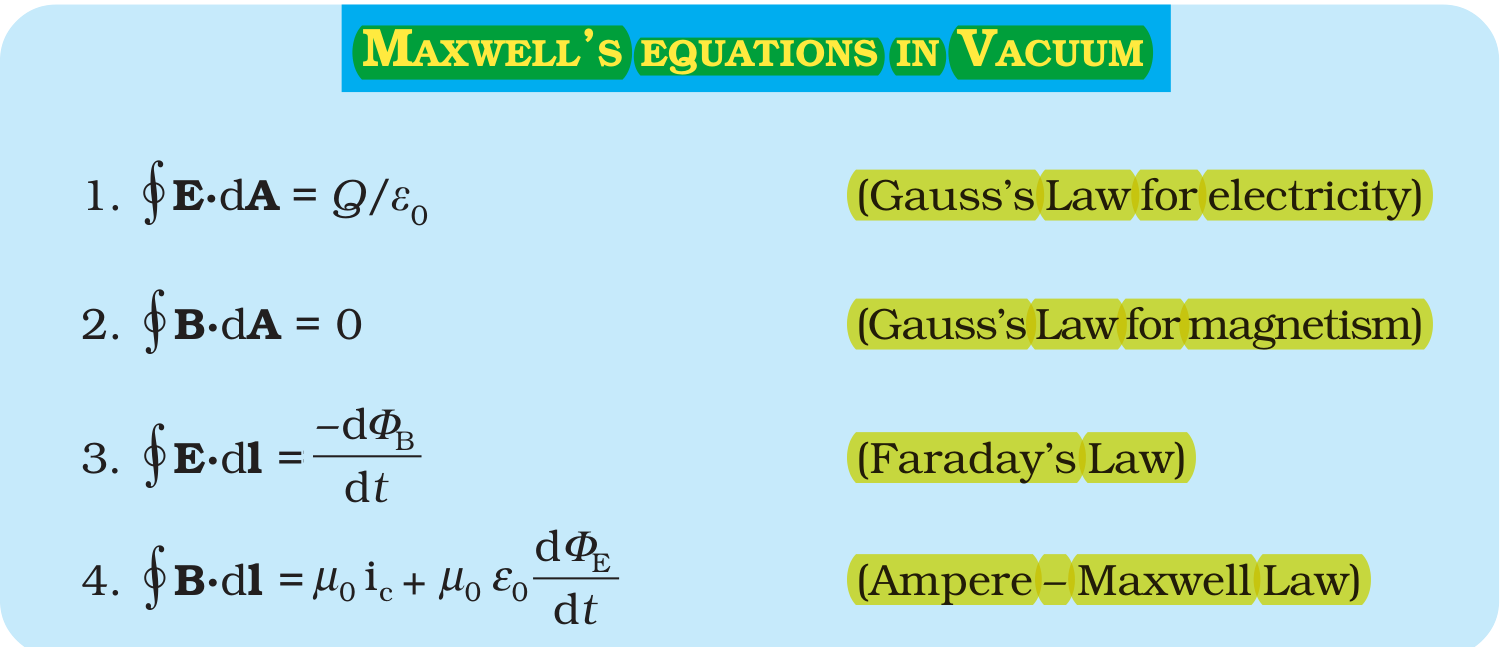
Match List - I with List - II.
| List - I | List - II |
| (A) \( \oint \vec{B}\cdot\vec{dl} = \mu_0 i_{c} + \mu_0\epsilon_0 \frac{d\phi_{E}}{dt} \) | (I) Faraday's Law |
| (B) \( \oint \vec{E}\cdot\vec{dl} = \frac{-d\phi_{B}}{dt} \) | (II) Gauss's Law for magnetism |
| (C) \( \oint \vec{B}\cdot\vec{dA} = 0 \) | (III) Ampere-Maxwell law |
| (D) \( \oint \vec{E}\cdot\vec{dA} = \frac{Q}{\epsilon_0} \) | (IV) Gauss's Law for electricity |
Choose the correct answer from the options given below :
Answer & explanation
Correct answer: option 2
The correct answer is Option (2) → (A)-(III), (B)-(I), (C)-(II), (D)-(IV)
These are the four Maxwell's equations: two line integrals (around a closed loop) and two surface integrals (over a closed surface).
(A) \( \oint \vec{B}\cdot\vec{dl} = \mu_0 i_{c} + \mu_0\epsilon_0\,d\phi_{E}/dt \) — this matches (III) Ampere-Maxwell law. The circulation of \( \vec{B} \) is set by the conduction current plus the displacement current \( \epsilon_0\,d\phi_E/dt \).
(B) \( \oint \vec{E}\cdot\vec{dl} = -d\phi_{B}/dt \) — this matches (I) Faraday's Law. A changing magnetic flux induces an emf around the loop.
(C) \( \oint \vec{B}\cdot\vec{dA} = 0 \) — this matches (II) Gauss's Law for magnetism. The net magnetic flux through any closed surface is zero, because isolated magnetic poles do not exist.
(D) \( \oint \vec{E}\cdot\vec{dA} = Q/\epsilon_0 \) — this matches (IV) Gauss's Law for electricity. The electric flux through a closed surface is the enclosed charge divided by \( \epsilon_0 \).
Note: A similar question was also asked in CUET (UG) 2026 on 21-05-2026 (Slot 1) and on 18-05-2026 (Slot 1), and in CUET (UG) 2023 on 13-06-2023 (Slot 2).
NCERT (2026-27):
Displacement Current – …