
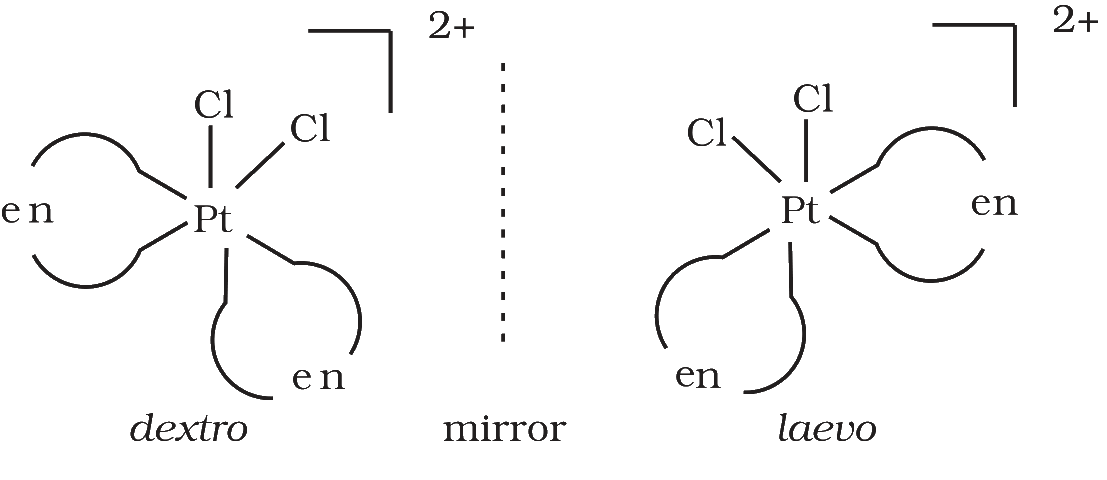
The figure shows the two optical isomers (d and l forms) of a complex ion of platinum with chlorido and ethane-1,2-diamine (en) ligands.
What is the oxidation number of platinum in this complex ion?
Answer & explanation
Correct answer: option 3
The correct answer is Option (3) → +4
The oxidation number of the central atom is the charge it would carry if all the ligands were removed along with the electron pairs they share with it. The figure shows, in each form, two Cl ligands and two en ligands bound to Pt, and a charge of 2+ on the whole ion, \( \ce{[PtCl2(en)2]^2+} \). Each chlorido ligand is Cl− (−1), and en is a neutral molecule (0).
Oxidation number of Pt (x)
\( \displaystyle x + 2(-1) + 2(0) = +2 \qquad x = \mathbf{+4} \)
NCERT (2026-27 edition):
5.2 Definitions of Some Important Terms Pertaining to Coordination Compounds – “The oxidation number of the central atom in a complex is defined as the charge it would carry if all the ligands are removed along with the electron pairs that are shared with the central atom.”
5.3.2 Naming of Mononuclear Coordination Compounds – “From the charge on the complex ion and the charge on the ligands, we can calculate the oxidation number of the metal. … Further, ethane-1,2–diamine is a neutral molecule, so the oxidation number of cobalt in the complex ion must be +3.”
Fig. 5.7: Optical isomers (d and l) of cis-[PtCl2(en)2]2+