In Sri Lanka, Sinhala language is the official language of the Nation. Out of the following, with which concept can this example be associated ?
Answer & explanation
Correct answer: option 1
The correct answer is Option (1) → Assimilationist
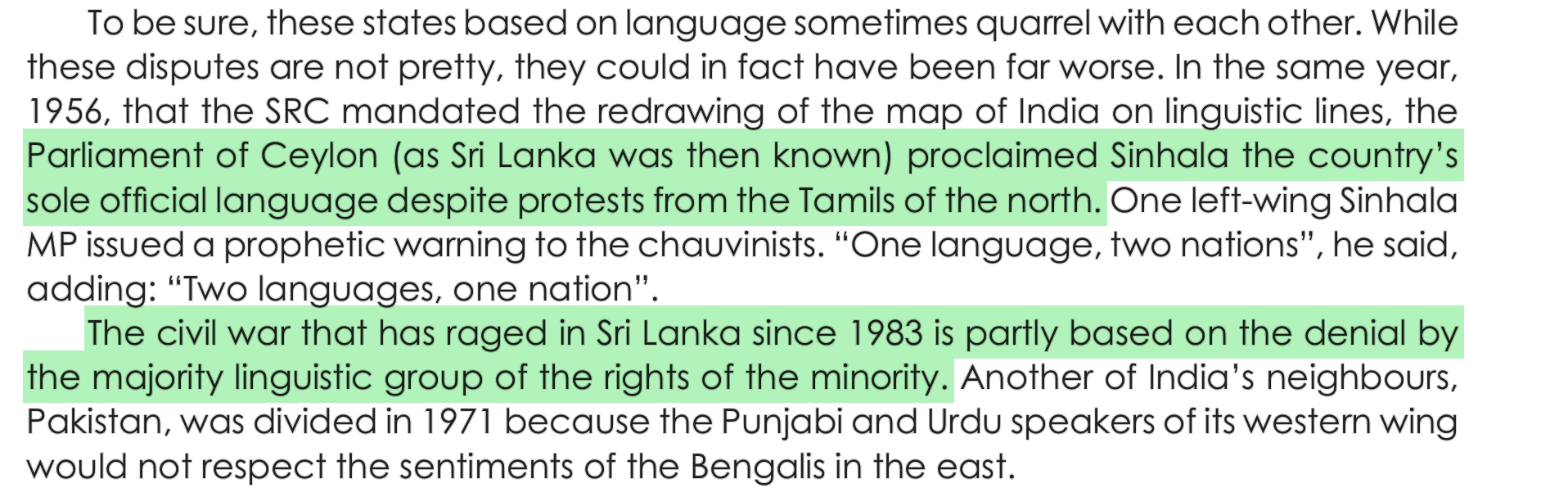
Option (1) Assimilationist — Correct. Policies of assimilation try to erode the cultural differences between groups, often by suppressing the identities of ethnic, religious or linguistic groups. One of their methods is adopting the dominant group’s language as the only official ‘national’ language. In 1956 the Parliament of Ceylon proclaimed Sinhala the sole official language despite protests from the Tamils of the north, and the civil war since 1983 is partly based on this denial of the minority’s rights.
Option (2) Protectionist — Incorrect. Protectionism is an economic policy: a country shields its own industries from foreign competition, for example by putting high taxes on imports. For instance, a heavy duty on imported cars protects the car makers at home. It has nothing to do with the language a state makes official.
Option (3) Nationalist — Incorrect. Nationalism is the feeling of belonging to a nation and the wish to keep it united. A state may claim national unity as its reason, but the policy of imposing the majority’s language on a minority has its own name in sociology: assimilation.
Option (4) Reductionist — Incorrect. Reductionism is a way of explaining a complex thing by reducing it to one simple part, as when all of human behaviour is explained by genes alone. It is a term about methods of explanation, not a state policy towards languages.
Note 1: The concepts in Options (2) and (4), ‘protectionist’ and ‘reductionist’, are not in NCERT (2025-26); explained here for the benefit of the students.
Note 2: The book gives the concept: one method of assimilationist policies is adopting the dominant group’s language as the only official ‘national’ language. In another place it gives the case: in 1956 Ceylon proclaimed Sinhala the sole official language despite Tamil protests. The answer comes from applying the concept to this case.
NCERT (2025-26): “6.1 The Importance of Community Identity … Policies of assimilation – often involving outright suppression of the identities of ethnic, religious or linguistic groups – try to erode the cultural differences between groups. Policies of integration seek to assert a single national identity by attempting to eliminate ethnonational and cultural differences from the public and political arena, while allowing them in the private domain. Both sets of policies assume a singular national identity. Assimilationist and integrationist strategies try to establish singular national identities through various interventions like:
Box 6.3, Linguistic States Helped Strengthen Indian Unity (continued) |