
CUETMOCK
  • Pricing
  • Mentors
Log inStart freeStart free mocks→

First test, then trust

Try a free CUET mock test.

Join 5,00,000+ students who rehearsed exam day on the exact NTA screen before sitting CUET. On the web and on Android.

Start free mocks →Get the Android app
CUETMOCK

India's #1 CUET Mock Test Platform. Original NCERT-based questions on the exact NTA exam screen — trusted by 5,00,000+ students since CUET 2022.

Get it onGoogle PlayScan to download the CUETMOCK app

Mock tests

  • CUET mock test series
  • Commerce mocks
  • Humanities (Arts) mocks
  • Science mocks
  • Languages & GAT mocks
  • Free practice questions
  • Pricing

Resources

  • CUET exam guide
  • CUET syllabus
  • Universities accepting CUET
  • Expert blogs
  • News & notifications
  • Webinars & counselling
  • CUET score calculator
  • How we estimate your rank
  • FAQs

Company

  • About us
  • Our leadership & team
  • Our toppers
  • Mentors
  • For schools
  • Contact us
  • Terms
  • Privacy
  • Refund policy

Talk to us

+91 7696 6630 56info@cuetmock.comWhatsApp us

Our other platforms

  • JEE Mock — For IIT-JEE aspirants
  • NEET Mock — For NEET aspirants

Newsletter

Exam updates, study material and offers — no spam.

© 2026 NYC Ventures Pvt. Ltd.

701-702, Royal Business Park, Zirakpur, Punjab - 140603

  • Terms of use
  • Privacy policy
  • Refund policy
  • Contact us

iCUETMOCK is an independent preparation platform, not affiliated with the National Testing Agency (NTA). Always check exam details on the official NTA website.

  • Home
  • Mock tests
  • CUET guide
  • Pricing
  • Log in
Home/Practice questions/Chemistry
ChemistryOrganic: Alcohols, Phenols and Ethers

The condensation reaction for converting Compound C to Compound F is…

Aspirin is a commonly used non-steroidal anti-inflammatory drug which reduces fever, relieves mild pain and decreases swelling. It is prepared by numerous synthetic methods; of which the acetylation of Compound A with acetyl chloride is one of the easiest methods. However, Compound A itself needs to be prepared from Compound B under basic conditions by using carbon dioxide as a reagent. Interestingly, Compound B along with Compound C can be obtained by the air oxidation of Compound D. Compound C is a commonly used industrial solvent and gives a positive iodoform test and a negative Tollen’s test. Compound C easily forms 2,4-DNP derivative (Compound E). Compound C on reaction with Ba(OH)2 under heating conditions produces Compound F whose molecular formula is C6H10O.

The condensation reaction for converting Compound C to Compound F is called ........, and the structure of Compound F is

Answer & explanation+

Correct answer: option 4

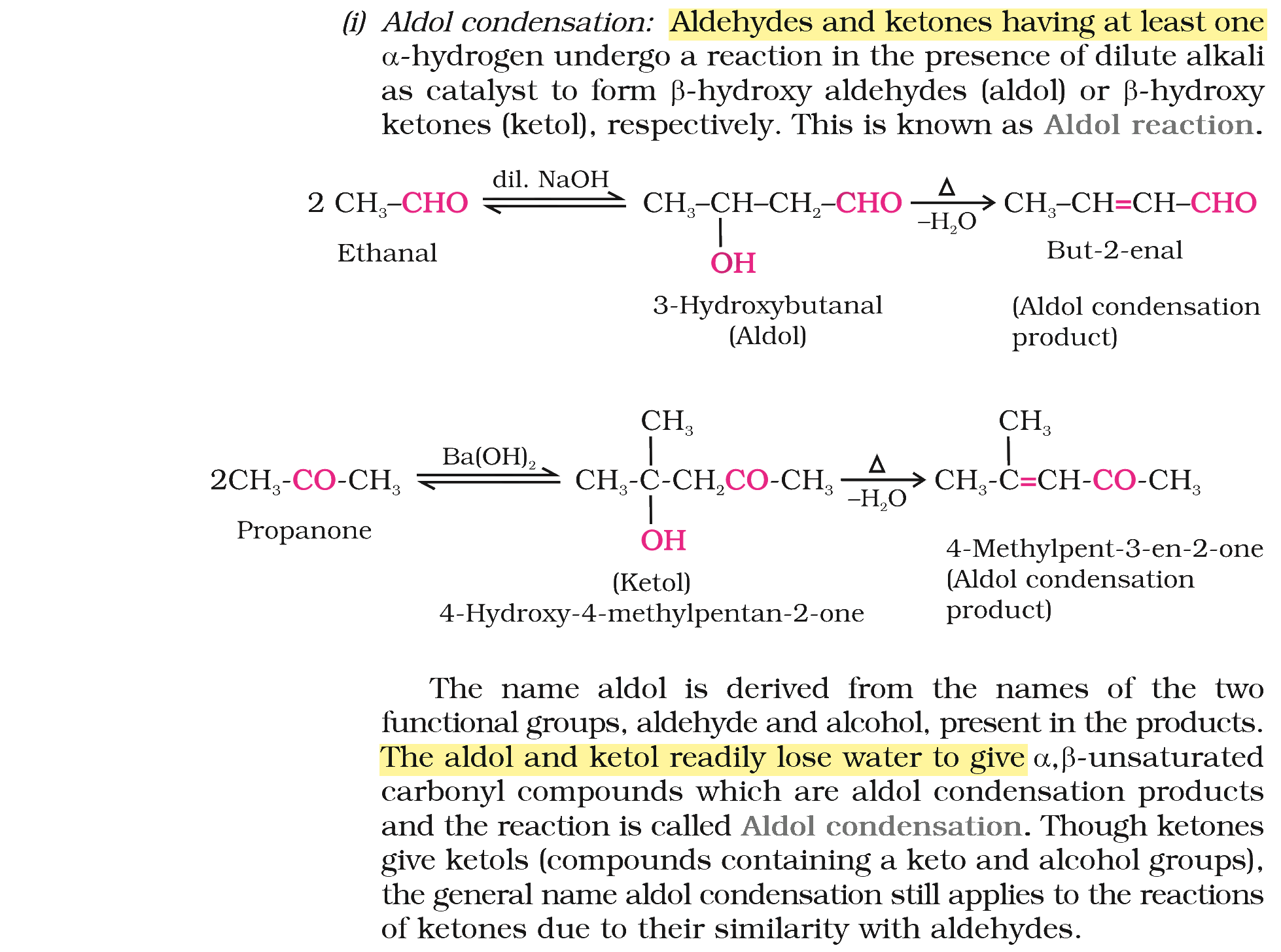
The correct answer is Option (4) → Aldol Condensation, 4-methylpent-3-en-2-one

An aldehyde or ketone with at least one α-hydrogen undergoes aldol condensation in the presence of a base. When two molecules of the same carbonyl compound react, it is called aldol condensation; when two different carbonyl compounds react, it is called cross-aldol condensation. The first product is a β-hydroxy carbonyl compound (the aldol or ketol), which loses water on heating and gives an α,β-unsaturated carbonyl compound.

Compound C is acetone (iodoform positive, Tollens’ negative, from the cumene process). With \( \ce{Ba(OH)2} \), two molecules of acetone give the ketol 4-hydroxy-4-methylpentan-2-one (\( \ce{C6H12O2} \)), which loses water on heating.

The product, 4-methylpent-3-en-2-one (mesityl oxide), has the formula C6H10O, which matches F. Only one carbonyl compound (acetone) is involved, so the reaction is aldol condensation, and F is the α,β-unsaturated ketone.

Why the other options are incorrect

  • Option (1) Aldol Condensation — Incorrect. The name is right, but the structure is the ketol 4-hydroxy-4-methylpentan-2-one (\( \ce{C6H12O2} \)), not the \( \ce{C6H10O} \) compound formed on heating.

  • Option (2) Cross-aldol Condensation — Incorrect. Both parts are wrong; only one carbonyl compound reacts, and the structure is the ketol, not F.

  • Option (3) Cross-aldol Condensation — Incorrect. The structure is right, but the reaction of acetone with itself is not a cross-aldol condensation.

NCERT (2026-27 edition):
Aldol Condensation
Textbook extract

Advertisement

Practise more on Organic: Alcohols, Phenols and Ethers

Chapter-wise mocks on the real NTA exam screen, with solutions and your rank. Your first mocks are free.

Start free mocks →

Advertisement

Next questions

  1. In what ratio must rice at ₹45 per kg is mixed with rice ₹60 per kg so that the mixture by worth ₹54 per kg ?Applied Maths. Section B2 · Numbers, Quantification and Numerical Applications
  2. During the reform period after 1991, what happened to the growth of the service sector?Economics · Indian Economic Development: Liberalisation, Privatisation and Globalisation - An Appraisal
  3. From the given statements, what conclusion can be made?Statements:Some men are wiseAll wise are professorsConclusion:I: Some men are profes…General Aptitude Test · Verbal Reasoning
  4. Re-arrange the recipients of 'Bharat Ratna' in the ascending order of the year of award:A. Dr. Rajendra PrasadB. Pt. Govind Ballabh PantC.…General Aptitude Test · General Knowledge
  5. Select the most appropriate meaning of the given Idiom:- "A taste of your own medicine"English · Grammar: Idioms
  6. Identify the principle of management from the above case study when each manager has to identify and send 3 workers for training.Business Studies · Principles of Management
  7. The acquired traits of the tribal communities include:Sociology · Indian Society: Continuity and Change
  8. TV Components Ltd., issued 10,000, 12% debentures of र100 each at a discount of 5% payable as follows: On application र40. On allotment र55…Accountancy Part A · Issue and Redemption of Debentures
  9. Which of the Continent has the highest Road Density in the world?Geography · Fundamentals of Human Geography: Transport and Communication
  10. If the inventory turnover ratio is divided into 365, it becomes a measure of:Accountancy Part B · Accounting Ratios