According to Keynesian economics, the value of APC can never be.
Answer & explanation
Correct answer: option 1
The correct answer is Option (1) → Zero
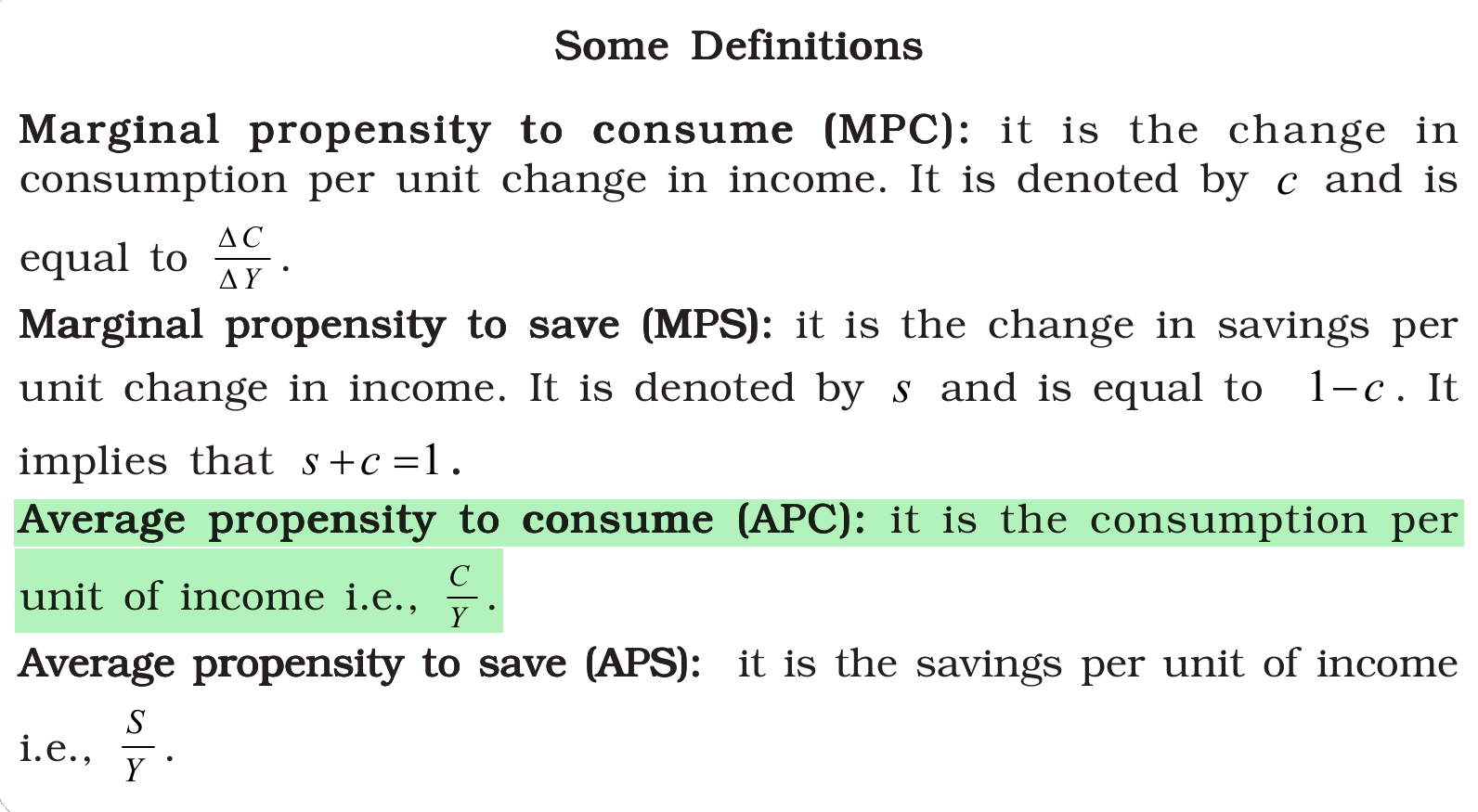
The average propensity to consume (APC) is consumption per unit of income, C/Y. People consume something even at zero income. This is autonomous consumption. So consumption never falls to zero, and APC can never be zero.
The other three values all occur as income rises:
At low income, consumption is more than income, so APC is more than one.
Where consumption equals income, APC is unity.
At high income, consumption is less than income, so APC is less than one.
NCERT (2026-27): “4.1.1. Consumption The most important determinant of consumption demand is household income. A consumption function describes the relation between consumption and income. The simplest consumption function assumes that consumption changes at a constant rate as income changes. Of course, even if income is zero, some consumption still takes place. Since this level of consumption is independent of income, it is called autonomous consumption.… Autonomous consumption is denoted by C and shows the consumption which is independent of income. If consumption takes place even when income is zero, it is because of autonomous consumption.…”
|