Observed the image and read the passage given below and answer the following questions:
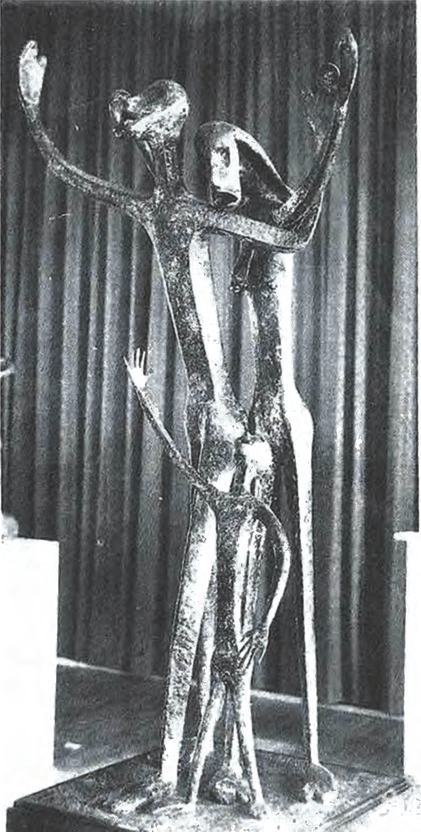
Although the artist only uses abstraction, in which three figures are stick-like and shown in flat rhythmical planes, yet it is easy to understand them as family-husband, wife and child. They are shown flinging their arms above and crying out for help in vain.
What is the message behind the sculpture?
Answer & explanation
Correct answer: option 1
The correct answer is Option (1) → The artist pays homage to millions of destitute
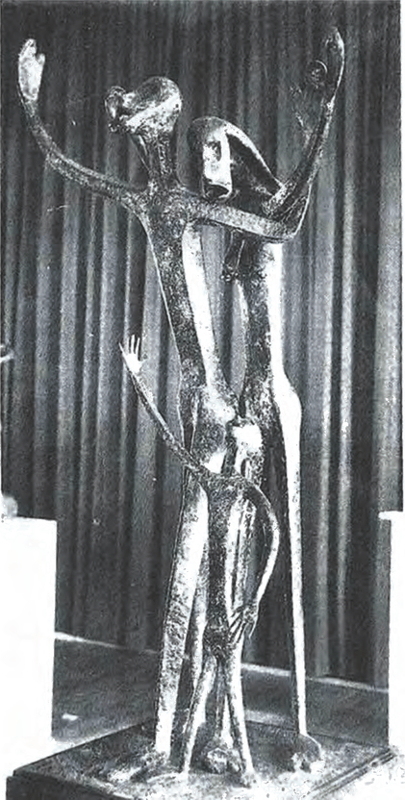
The sculpture is Cries Un-heard by Amarnath Sahgal (1958). The family flings up its arms and cries for help in vain. It can be read as a socialist work, in which the artist pays homage to millions of destitute families whose cries fall on deaf ears.
Option (1) The artist pays homage to millions of destitute — Correct.
Option (2) Wrestling with human — Incorrect. Wrestling is the theme of Triumph of Labour, where men are wrestling with nature; here a family cries for help.
Option (3) Influence of Ancient Temple — Incorrect. The influence of ancient temple sculpture is seen in Janakiram’s Ganesha; this work is abstract and modern.
Option (4) Understanding traditional imagery — Incorrect. The figures are abstract, stick-like forms, not traditional images; the work speaks of helpless people.
NCERT (2026-27): “Cries Un-heard …Through the medium of sculpture, their helplessness expressed by the hand gesture is turned into a permanent shape. It is possible for us to read this work as socialist, whereby, the artist pays homage to millions of destitute families in need of help, whose cries fall on deaf ears. None other than socialist poet, Mulk Raj Anand, wrote movingly about this work, which now is in the collection of the National Gallery of Modern Art, New Delhi.”
Cries Un-heard |