
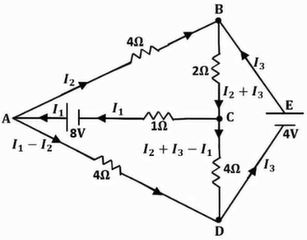
Applying the Kirchhoff's rule to the loop (a) ABCA and (b) BCDEB, two correct equations are given
(A) \( 8 - 4I_2 - 2(I_2 + I_3) - I_1 = 0 \)
(B) \( 4 - 2(I_2 + I_3) - 4(I_2 + I_3 - I_1) = 0 \)
(C) \( 4 + 2(I_2 - I_3) - 4(I_2 + I_3 - I_1) = 0 \)
(D) \( 8 + 4I_2 + 2(I_2 - I_3) - I_1 = 0 \)
Choose the correct answer from the options given below:
Answer & explanation
Correct answer: option 1
The correct answer is Option (1) → (A) and (B) only
By Kirchhoff's loop rule, the changes in potential around any closed loop add to zero: along the marked current each resistor gives a drop \( -IR \), and a cell crossed from its negative to its positive plate gives a rise \( +E \).
Readings from the figure for the two loops:
\( \mathrm{AB}: 4\,\Omega,\ I_2 \)
\( \mathrm{BC}: 2\,\Omega,\ I_2 + I_3 \)
\( \mathrm{CA}: 1\,\Omega \text{ and the } 8\,\mathrm{V} \text{ cell},\ I_1 \)
\( \mathrm{CD}: 4\,\Omega,\ I_2 + I_3 - I_1 \)
\( \mathrm{DEB}: 4\,\mathrm{V} \text{ cell},\ I_3 \)
(a) Loop ABCA. Every part is crossed along its current; the 8 V cell is crossed from negative to positive between C and A.
\( \displaystyle -4I_2 - 2(I_2 + I_3) - 1 \times I_1 + 8 = 0 \)
(b) Loop BCDEB. BC and CD are crossed along their currents; DEB has only the 4 V cell, crossed from negative to positive.
\( \displaystyle -2(I_2 + I_3) - 4(I_2 + I_3 - I_1) + 4 = 0 \)
(A) \( 8 - 4I_2 - 2(I_2 + I_3) - I_1 = 0 \) — Correct. It is the loop equation for ABCA.
(B) \( 4 - 2(I_2 + I_3) - 4(I_2 + I_3 - I_1) = 0 \) — Correct. It is the loop equation for BCDEB.
(C) \( 4 + 2(I_2 - I_3) - 4(I_2 + I_3 - I_1) = 0 \) — Incorrect. The \( 2\,\Omega \) resistor carries \( I_2 + I_3 \), not \( I_2 - I_3 \), and its term is a drop, \( -2(I_2 + I_3) \).
(D) \( 8 + 4I_2 + 2(I_2 - I_3) - I_1 = 0 \) — Incorrect. A to B along \( I_2 \) is a drop, \( -4I_2 \); the BC term is wrong as in (C).
Note: NTA picked this question from an NCERT (2026-27) example and changed the figures. Do not ignore NCERT while practising numericals.
NCERT (2026-27):
Kirchhoff’s Rules – “… Example 3.6 Determine the current in each branch of the network shown in Fig. 3.17.”
Kirchhoff’s Rules – “… For the closed loop ABCA, we get
\( \displaystyle 10 - 4I_2 - 2\,(I_2 + I_3) - I_1 = 0 \)
that is,
\( \displaystyle I_1 + 6I_2 + 2I_3 = 10 \qquad [3.61(b)] \)
For the closed loop BCDEB, we get
\( \displaystyle 5 - 2\,(I_2 + I_3) - 2\,(I_2 + I_3 - I_1) = 0 \)
that is,
\( \displaystyle 2I_1 - 4I_2 - 4I_3 = -5 \qquad [3.61(c)] \)”