
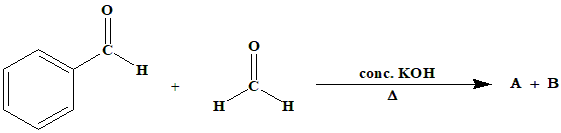
Identify \(A\) and \(B\):
Answer & explanation
Correct answer: option 2
The correct answer is Option (2) → Benzyl alcohol (C6H5CH2OH) and potassium formate (HCOO−K+)
Neither benzaldehyde nor formaldehyde has an α-hydrogen, so with concentrated KOH they undergo the Cannizzaro reaction (self oxidation–reduction). When two such aldehydes are mixed (crossed Cannizzaro reaction), formaldehyde is always the one oxidised, because its carbonyl carbon is the most open to attack by \( \ce{OH^{-}} \); the hydride ion it releases reduces the other aldehyde.
\( \ce{C6H5CHO + HCHO} \xrightarrow{\text{conc. KOH, }\Delta} \ce{C6H5CH2OH + HCOO^- K^+} \)
HCHO is oxidised to the formate ion and \( \ce{C6H5CHO} \) is reduced to benzyl alcohol.
Why the other options are incorrect
Option (1) — Incorrect. Potassium benzoate with acetaldehyde — the Cannizzaro reaction gives an alcohol and a carboxylate, never a new aldehyde; and in the crossed reaction HCHO, not \( \ce{C6H5CHO} \), is oxidised.
Option (3) — Incorrect. Potassium benzyloxide with potassium acetate — an acetate (two carbons) cannot come from a one-carbon aldehyde.
Option (4) — Incorrect. Potassium benzoate with potassium formate — both aldehydes oxidised; the Cannizzaro reaction always pairs one oxidation with one reduction.
Note: The question is from beyond the NCERT textbook.
NCERT (2026-27 edition):
Cannizzaro Reaction
