
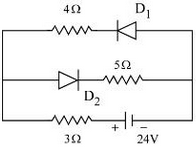
If the diodes \( D_1 \) and \( D_2 \) are ideal in given diagram. The current flowing in the circuit is
Answer & explanation
Correct answer: option 4
The correct answer is Option (4) → \( 3\,\mathrm{A} \)
An ideal diode has zero resistance when forward biased (current along its arrow) and infinite resistance when reverse biased. First find the direction in which the battery drives current through the two upper branches.
The positive terminal of the 24 V battery is on the left. Current leaves it through the \( 3\,\Omega \) resistor, goes up the left side and then flows from left to right through the upper branches before returning to the negative terminal.
\( D_2 \text{ (arrow pointing right): forward biased, conducts} \)
\( D_1 \text{ (arrow pointing left): reverse biased, no current} \)
So the branch with \( 4\,\Omega \) and \( D_1 \) carries no current, and the circuit is a single loop of the battery, the \( 3\,\Omega \) resistor and the \( 5\,\Omega \) resistor in series.
\( \displaystyle I = \frac{V}{R_{\mathrm{total}}} = \frac{24\,\mathrm{V}}{3\,\Omega + 5\,\Omega} = \frac{24}{8} = 3\,\mathrm{A} \)