Read the paragraph and answer the Question given below:
Humans are sexually reproducing and viviparous. The male reproductive system is composed of a pair of testes the male sex accessory ducts and the accessory glands and external genitalia. The female reproductive system consists of a pair of ovaries a pair of oviducts, a uterus, a vagina, external genitalia and pair of mammary glands. The reproductive cycle of female primates is called menstrual cycle. Menstrual cycle starts only after attaining sexual maturation (puberty). Coitus followed by fertilization leads to formation of zygote. After 9 months of pregnancy, the fully developed foetus is ready for delivery.
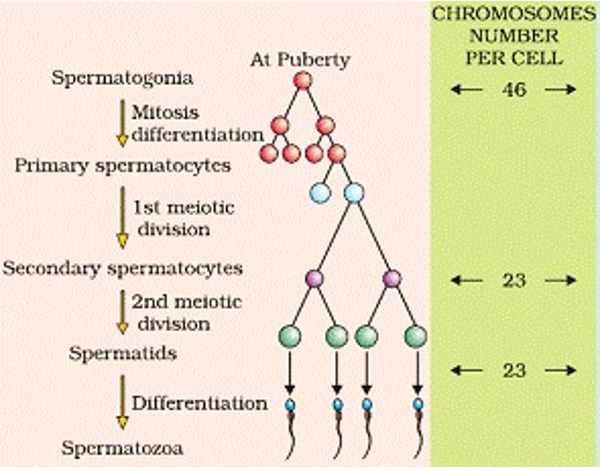
How many chromosomes are present in human primary spermatocytes?
Answer & explanation
Correct answer: option 1
The correct answer is Option (1) → 46
The primary sex organs – the testis in the males produce gametes, i.e, sperms by the process called gametogenesis.
In testis, the immature male germ cells (spermatogonia) produce sperms by spermatogenesis that begins at puberty.
The spermatogonia (sing. spermatogonium) present on the inside wall of seminiferous tubules multiply by mitotic division and increase in numbers.
Each spermatogonium is diploid and contains 46 chromosomes. Some of the spermatogonia called primary spermatocytes periodically undergo meiosis.
A primary spermatocyte completes the first meiotic division (reduction division) leading to formation of two equal, haploid cells called secondary spermatocytes, which have only 23 chromosomes each.
The secondary spermatocytes undergo the second meiotic division to produce four equal, haploid spermatids. But a single secondary spermatocyte will produce only 2 sperms.The spermatids are transformed into spermatozoa (sperms) by the process called spermiogenesis.
After spermiogenesis, sperm heads become embedded in the Sertoli cells, and are finally released from the seminiferous tubules by the process called spermiation.