CUETMOCK
  • Pricing
  • Mentors
Log inStart freeStart free mocks→

First test, then trust

Try a free CUET mock test.

Join 5,00,000+ students who rehearsed exam day on the exact NTA screen before sitting CUET. On the web and on Android.

Start free mocks →Get the Android app
CUETMOCK

India's #1 CUET Mock Test Platform. Original NCERT-based questions on the exact NTA exam screen — trusted by 5,00,000+ students since CUET 2022.

Get it onGoogle PlayScan to download the CUETMOCK app

Mock tests

  • CUET mock test series
  • Browse all papers
  • Commerce mocks
  • Humanities (Arts) mocks
  • Science mocks
  • Languages & GAT mocks
  • Free practice questions
  • Pricing

Resources

  • CUET exam guide
  • CUET syllabus
  • Universities accepting CUET
  • Expert blogs
  • News & notifications
  • Webinars & counselling
  • CUET score calculator
  • How we estimate your rank
  • FAQs

Company

  • About us
  • Our leadership & team
  • Our toppers
  • Mentors
  • For schools
  • Contact us
  • Terms
  • Privacy
  • Refund policy

Talk to us

+91 7696 6630 56info@cuetmock.comWhatsApp us

Our other platforms

  • JEE Mock — For IIT-JEE aspirants
  • NEET Mock — For NEET aspirants

Newsletter

Exam updates, study material and offers — no spam.

© 2026 NYC Ventures Pvt. Ltd.

701-702, Royal Business Park, Zirakpur, Punjab - 140603

  • Terms of use
  • Privacy policy
  • Refund policy
  • Contact us

iCUETMOCK is an independent preparation platform, not affiliated with the National Testing Agency (NTA). Always check exam details on the official NTA website.

  • Home
  • Mock tests
  • CUET guide
  • Pricing
  • Log in
Home/Practice questions/Political Science
Political ScienceContemporary World Politics: Environment and Natural Resources

What is the context of this passage?

On the basis of the given passage answer the following questions.

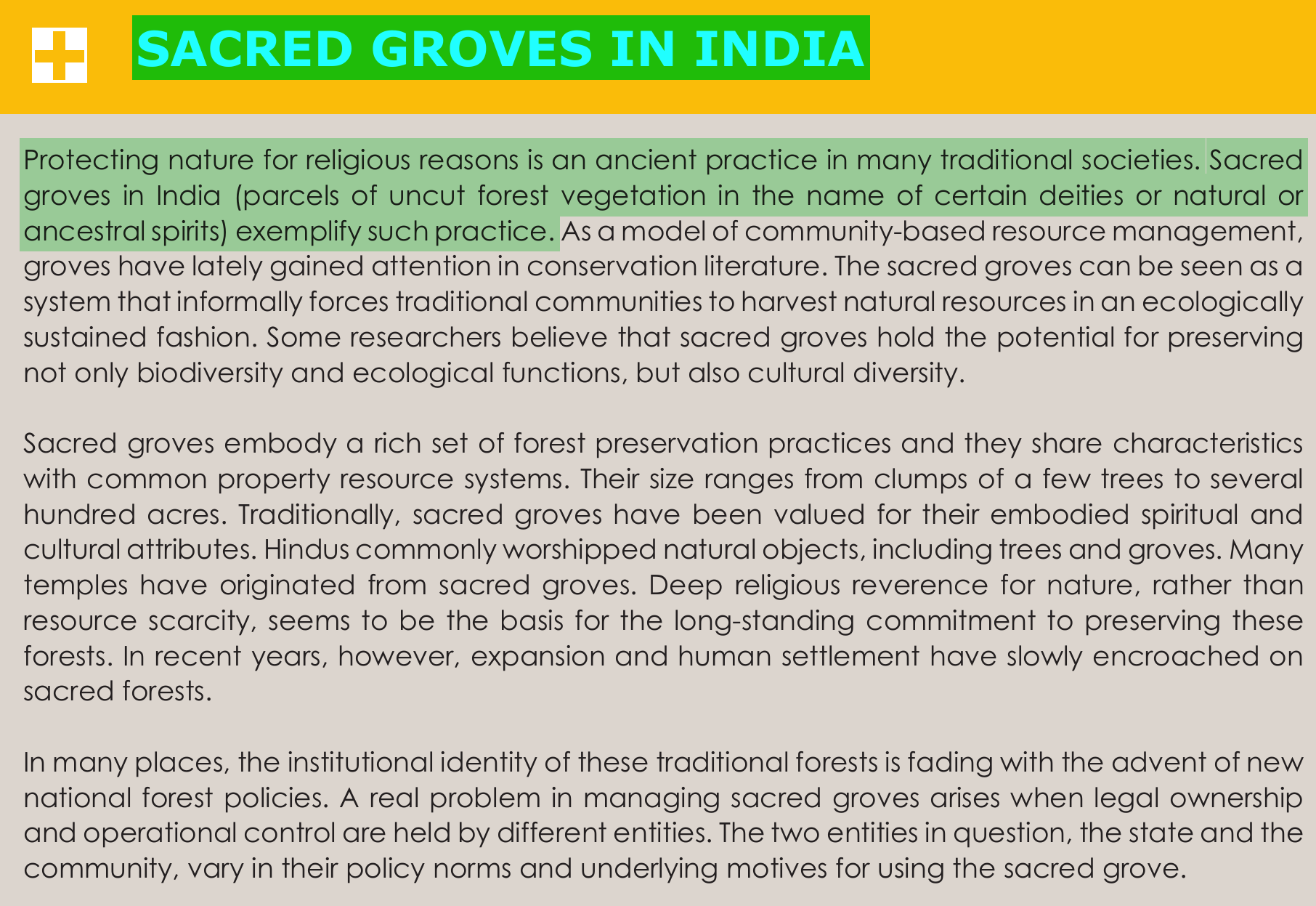
Protecting nature for religious reasons is an ancient practice in many traditional societies. Sacred groves in India (parcels of uncut forest vegetation in the name of certain deities or natural or ancestral spirits) exemplify such practice. As a model of community based resource management groves have lately gained attention in conservation literature. The sacred groves can be seen as a system that informally forces traditional communities to harvest natural resources in an ecologically sustained fashion. Some researchers believe that sacred groves hold the potential for preserving not only biodiversity and ecological functions but also cultural diversity.

Sacred groves embody a rich set of forest preservation practices and they share characteristics with common property resource systems. Their size ranges from clumps of a few trees to several hundred acres. Traditionally, sacred groves have been valued for their embodied spiritual and cultural attributes. People commonly worshipped natural objects, including trees and groves. Many temples have originated from sacred groves. Deep religious reverence for nature, rather than resource scarcity, seems to be the basis for the long-standing commitment to preserving these forests.

In recent years, however, expansion and human settlement have slowly encroached on sacred forests. In many places, the institutional identity of these traditional forests is fading with the advent of new national forest policies. A real problem in managing sacred groves arises when legal ownership and operational control are held by different entities. The two entities in question, the state and the community, vary in their policy norms and underlying motives for using the sacred grove.

What is the context of this passage?

Answer & explanation+

Correct answer: option 1

The correct answer is Option (1) → Sacred groves in India

Option (1) Sacred groves in India — Correct. Every line of the passage is about sacred groves in India: what they are, why they are preserved, and the problem of managing them today.

Option (2) Forest in India — Incorrect. The passage speaks of one kind of forest only, the groves kept in the name of deities and spirits.

Option (3) Environmental policies in India — Incorrect. National forest policies come up in only one line, as a reason why the identity of the groves is fading.

Option (4) Forest conservation — Incorrect. Conservation is the theme of the groves, but the passage is about the sacred groves, not about forest conservation in general.

Hence, the answer is Option (1).


NCERT (2026-27): Contemporary World Politics — Chapter 6: Environment and Natural Resources

NCERT extract

Box ‘Sacred Groves in India’, chapter ‘Environment and Natural Resources’ (2026-27): Sacred Groves in India

Advertisement

Practise more on Contemporary World Politics: Environment and Natural Resources

Chapter-wise mocks on the real NTA exam screen, with solutions and your rank. Your first mocks are free.

Start free mocks →

Advertisement

Next questions

  1. Construction of new houses in an economy during a year is which category of investment?Economics · Macro Economics: National Income Accounting
  2. Which letter will come next in the following series? R, M, I, F, D, ?General Aptitude Test · General Ability
  3. Evidence shows that ‘they’ hunted with stone weapons but essentially ate fruit. Who are ‘they’?Biology · Evolution
  4. "The entrepreneurial decision is an investment decision that augments the productive capacity of the economy". Identify the function of ent…Business Studies · Entrepreneurship Development
  5. Which of the following economic activities belong to "Secondary sector"?Economics · Indian Economic Development: Employment - Growth, Informalisation and Other Issues
  6. 'अपनी नैया आप ही बनाना' का अर्थ है-Hindi · Comprehension - (Narrative / Factual)
  7. In the nuclear reaction _6 C^11 → _5 B^11+β^++X, what does X stand forPhysics · Nuclei
  8. सूची - I के साथ सूची - II का मिलान कीजिए।सूची - Iसूची - II(A) सगे-सम्बन्धियों के लिए पत्र(I) शिकायती पत्र(B) नौकरी के लिए(II) प्रार्थना पत्…Hindi · पत्र लेखन
  9. In which coastal town did Mahatma Gandhi break 'Salt law'?General Aptitude Test · General Knowledge
  10. Arrange the following elements of the organising process in a logical sequence. (A) Assigning duties to personnel (B) Dividing the work int…Business Studies · Organising