Read the paragraph carefully and answer the following questions:
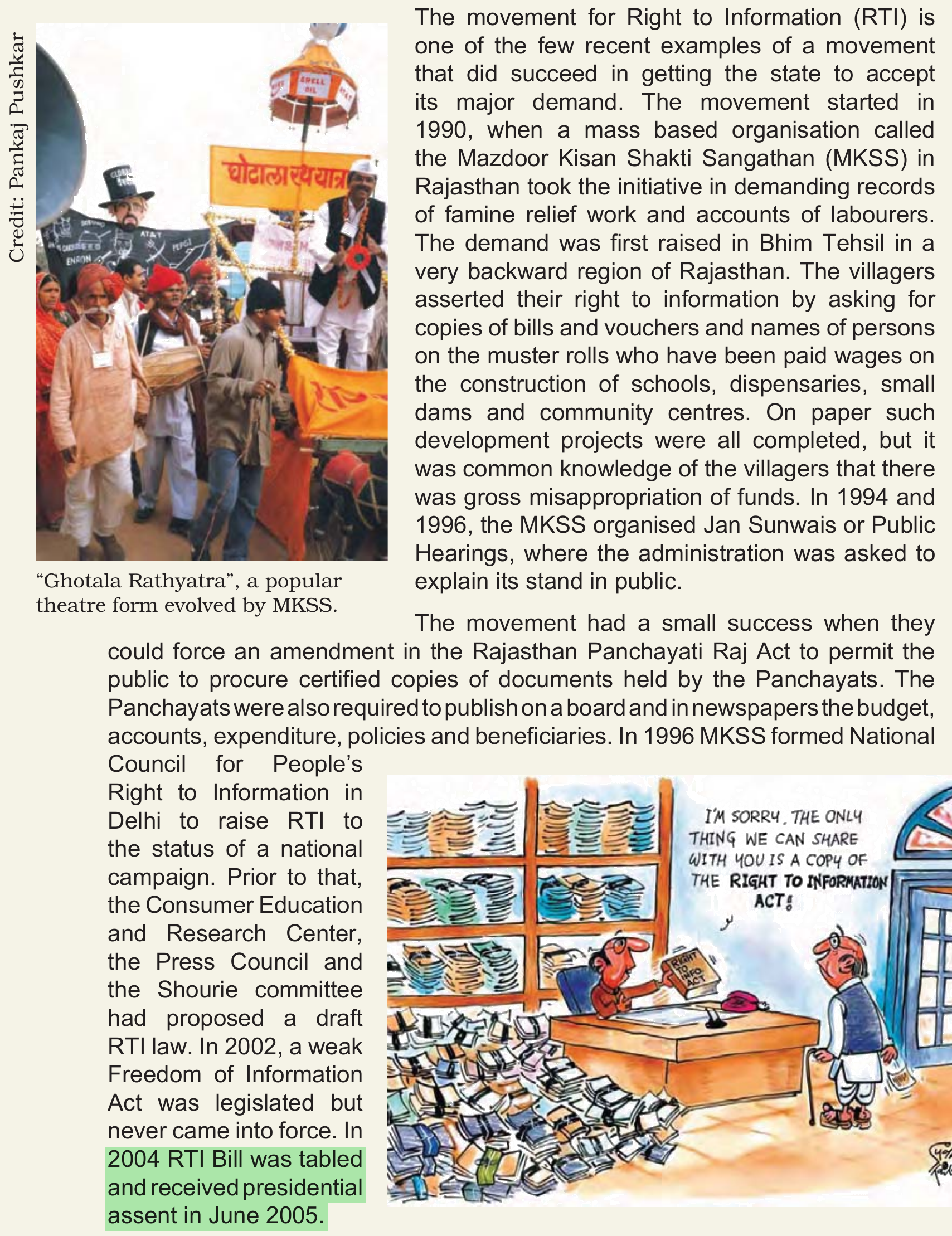
The movement for Right to information (RTI) is one of the few recent examples of a movement that did succeed in getting the state to accept its major demand. The movement started in 1990, when a mass based organisation called the Mazdoor Kisan Shakti Sangathan (MKSS) in Rajasthan took the initiative in demanding records of famine relief work and accounts of labourers. The demand was first raised in Bhim Tehsil in a very backward region of Rajasthan. The villagers asserted their right to information by asking for copies of bills and vouchers and names of persons on the muster rolls who have been paid wages on the construction of schools, dispensaries, small dams and community centres. On paper such development projects were all completed, but it was common knowledge of the villagers that there was gross misappropriation of funds. In 1994 and 1996, the MKSS organised Jan Sunwais or Public Hearings, where the administration was asked to explain its stand in public.
When did the RTI Bill receive presidential assent?
Answer & explanation
Correct answer: option 3
The correct answer is Option (3) → June 2005
The RTI Bill was tabled in 2004 and received presidential assent in June 2005; a weak Freedom of Information Act of 2002 had never come into force.
Note 1: The passage of this question is taken from the chapter ‘Rise of Popular Movements’, which was there in the pre-rationalised NCERT and has been deleted from subsequent editions of NCERT, including the NCERT book (2026-27).
Note 2: A same/similar question was asked in CUET (UG) in the papers below.
| 2026 | 2025 | 2024 | 2023 | 2022 |
| – | – | – | 05-06 S2* 06-06 S3* 09-06 S1* 09-06 S3* 10-06 S1 10-06 S3* 12-06 S2* 18-06 S1* 18-06 S2* | – |
* A similar question.
NCERT (Pre-rationalised): Politics in India since Independence — Chapter 7: Rise of Popular Movements
|