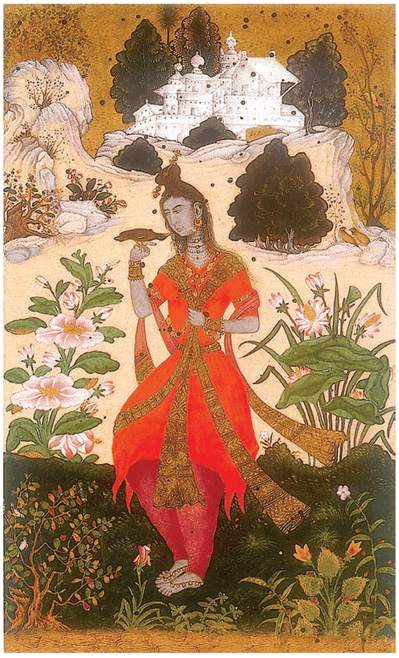
The Deccani painting Yogini comes from Bijapur. Given below are four statements about it:
(A) The artist prefers a vertical composition.
(B) The Yogini is preoccupied with a parrot, as if in conversation.
(C) A group of white structures at the top acts as a tapering visual note.
(D) The long scarves of the Yogini fall straight down beside her body.
Choose the correct answer from the options given below:
Answer & explanation
Correct answer: option 1
The correct answer is Option (1) → (A) and (C) only
(A) The artist prefers a vertical composition. — Correct. The artist prefers a vertical composition, built on the long standing figure of the Yogini.
(B) The Yogini is preoccupied with a parrot, as if in conversation. — Incorrect. She is preoccupied with a myna bird, not a parrot.
(C) A group of white structures at the top acts as a tapering visual note. — Correct. The white structures right at the top complement the figure as a tapering, visual note.
(D) The long scarves of the Yogini fall straight down beside her body. — Incorrect. The long scarves swirl in a rhythmic circle around her body.
Note: This topic was not named in the CUET 2026 syllabus, but it was part of the NCERT chapter. In 2025 and 2026, NTA also asked questions on topics in NCERT that the CUET syllabus did not name. So our mocks have questions from every part of the NCERT chapter, to give you enough practice. Read the whole chapter, not only the sub-topics named in the syllabus.
NCERT (2026-27): “Bijapur School of Painting …The theme of another Deccani painting is Yogini … This work is attributed to an artist, about whom we do not have any record. It is to be noted that the artist prefers a vertical composition, where the long standing figure of the Yogini is complimented by a group of white structures right at the top, as a tapering, visual note. The Yogini is preoccupied with a myna bird as if in conversation. The Yogini is adorned with jewellery and her hair bun elongates her visual presence. The long scarves swirl in rhythmic circle around her body, which has exquisite flora surrounding it in exquisite landscape.”
Yogini, Bijapur, seventeenth century, The Chester Beatty Library, Dublin, Ireland |