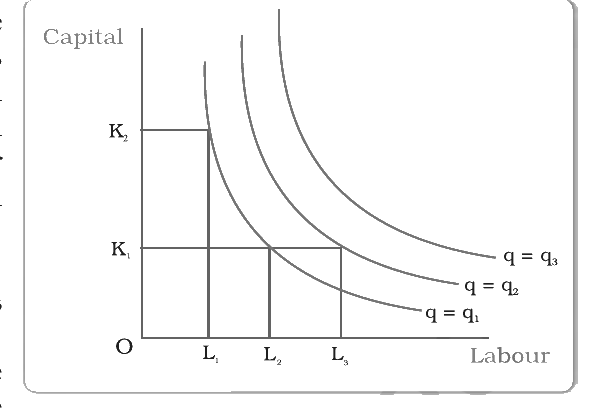
When the marginal products of both inputs are positive, isoquants are negatively sloped. Why?
Answer & explanation
Correct answer: option 2
The correct answer is Option (2) → With more of one input, the same output needs less of the other input.
All points on an isoquant give the same output. If both marginal products are positive, more of one input raises output, so the other input must be cut to keep output the same. That gives the isoquant its negative slope.
Option (1) To produce a larger output, a greater amount of both inputs is needed. — Incorrect. A larger output means moving to a higher isoquant, not along the same one.
Option (2) With more of one input, the same output needs less of the other input. — Correct. More of one input goes with less of the other.
Option (3) The marginal product of each input first rises and then falls. — Incorrect. This is the law of variable proportions, about one input with the other fixed. It does not give the slope of an isoquant.
Option (4) Each isoquant represents a different level of output. — Incorrect. This is true, but it is about different isoquants, not the slope of one.
NCERT (2026-27): “Isoquant … If we fix capital at K1 and increase labour to L3, output increases and we reach a higher isoquant, q = q2. When marginal products are positive, with greater amount of one input, the same level of output can be produced only using lesser amount of the other. Therefore, isoquants are negatively sloped.” “Isoquant In Chapter 2, we have learnt about indifference curves. Here, we introduce a similar concept known as isoquant. It is just an alternative way of representing the production function. Consider a production function with two inputs labour and capital. An isoquant is the set of all possible combinations of the two inputs that yield the same maximum possible level of output. Each isoquant represents a particular level of output and is labelled with that amount of output. …”
|