Read the passage and answer the questions:
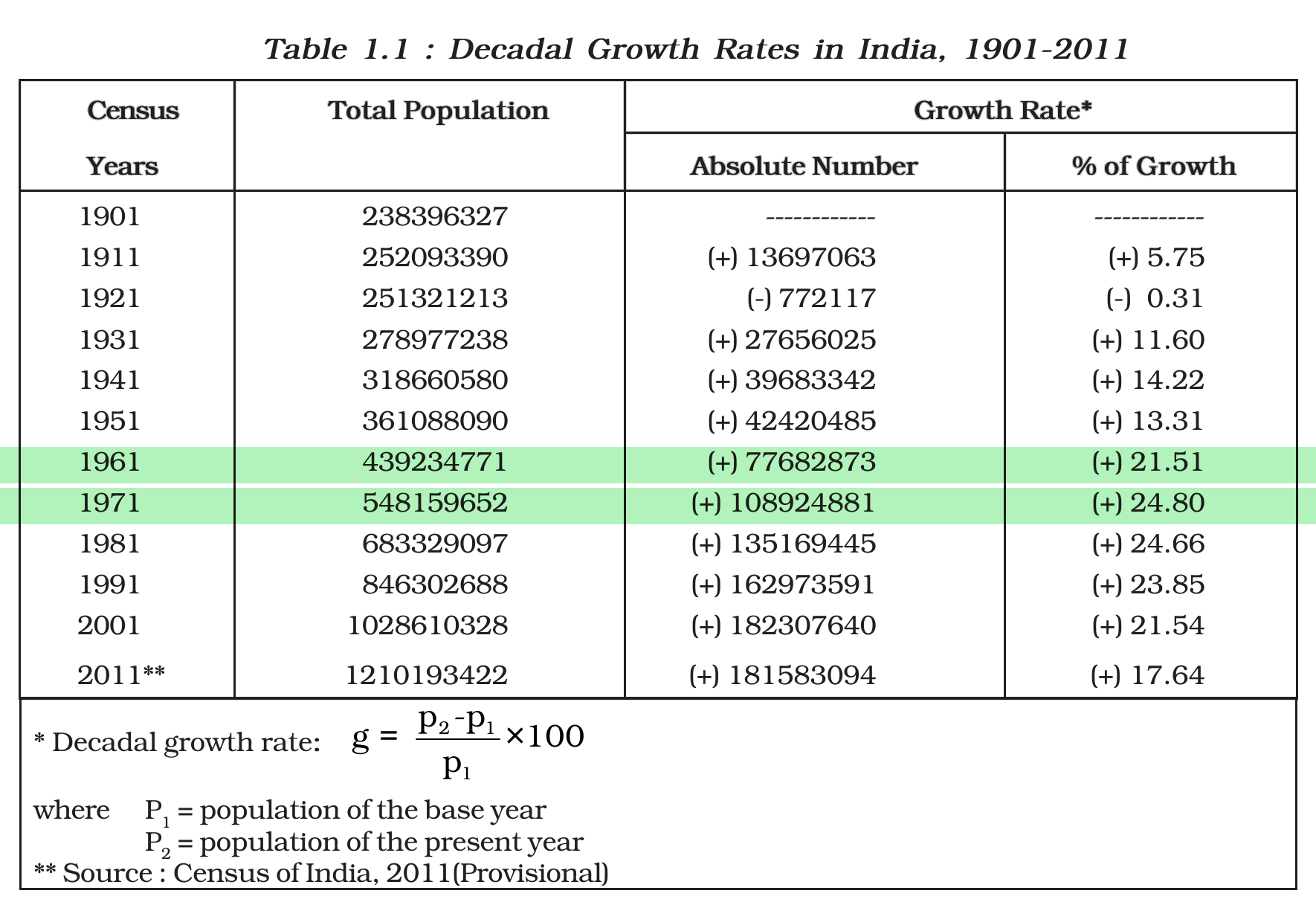
Decadal Growth Rates in India, 1901-2011
| Census Years | Total Population | Absolute Number | % of Growth |
| 1901 | 238396327 | — | — |
| 1911 | 252093390 | (+) 13697063 | (+) 5.75 |
| 1921 | 251321213 | (-) 772117 | (-) 0.31 |
| 1931 | 278977238 | (+) 27656025 | (+) 11.60 |
| 1941 | 318660580 | (+) 39683342 | (+) 14.22 |
| 1951 | 361088090 | (+) 42420485 | (+) 13.31 |
| 1961 | 439234771 | (+) 77682873 | (+) 21.51 |
| 1971 | 548159652 | (+) 108924881 | (+) 24.80 |
| 1981 | 683329097 | (+) 135169445 | (+) 24.66 |
| 1991 | 846302688 | (+) 162973591 | (+) 23.85 |
| 2001 | 1028610328 | (+) 182307640 | (+) 21.54 |
| 2011** | 1210193422 | (+) 181583094 | (+) 17.64 |
* Decadal growth rate: \( g = \displaystyle\frac{P_2 - P_1}{P_1} \times 100 \)
where
\( P_1 = \text{population of the base year} \)
\( P_2 = \text{population of the present year} \)
Source: Census of India, 2011 (Provisional)
Which of the following is NOT true?
Answer & explanation
Correct answer: option 4
The correct answer is Option (4) → The decade 1951-61 experienced the highest population growth after independence due to partition.
Option (1) The growth of population is higher in post independence era rather than in pre-independence era. — True (Incorrect). Before 1951 the decadal growth never reached 15 per cent; after 1951 it stayed above 17 per cent in every decade.
Option (2) Decadal growth rate is calculated on the basis of base year and present year populations. — True (Incorrect). The formula uses P1, the population of the base year, and P2, the population of the present year.
Option (3) The period from 1901 to 1921 is referred to as a period of stationary phase of growth of India’s population. — True (Incorrect). 1901-1921 is called the stagnant or stationary phase, when the growth rate was very low.
Option (4) The decade 1951-61 experienced the highest population growth after independence due to partition. — Not true (Correct). The highest growth was in 1961-71 (24.80 per cent), not 1951-61 (21.51 per cent). The rapid growth of 1951-1981 came from a sharp fall in the death rate with a high birth rate, not from partition.
NCERT (2025-26): “Growth of Population … Phase I : The period from 1901-1921 is referred to as a period of stagnant or stationary phase of growth of India’s population, since in this period growth rate was very low, even recording a negative growth rate during 1911-1921. Both the birth rate and death rate were high keeping the rate of increase low (Appendix–iii). Poor health and medical services, illiteracy of people at large and inefficient distribution system of food and other basic necessities were largely responsible for a high birth and death rates in this period.… Phase III : The decades 1951-1981 are referred to as the period of population explosion in India, which was caused by a rapid fall in the mortality rate but a high fertility rate of population in the country. The average annual growth rate was as high as 2.2 per cent.…”
|