The government imposed lower limit on the price that may be charged for a particular good or service is called?
Answer & explanation
Correct answer: option 2
The correct answer is Option (2) → Price floor
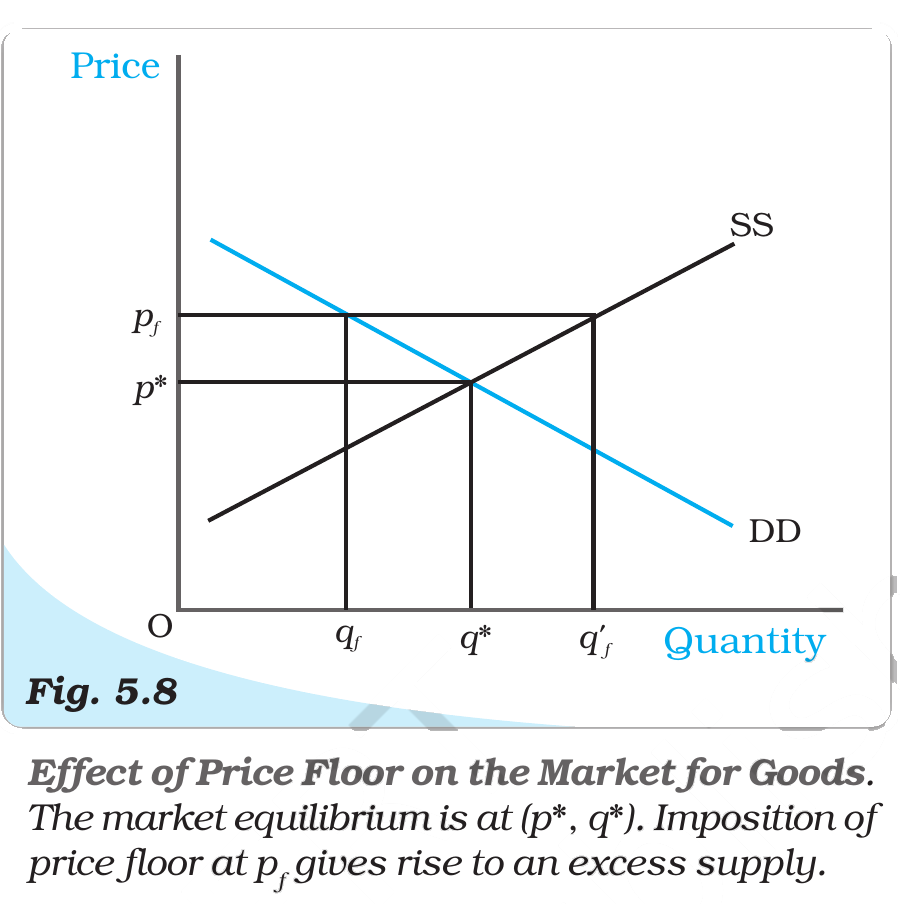
Sometimes the market price is too low for the government’s liking: farmers may not earn enough from their crops, or workers from their wages. It then fixes a lower limit below which the price may not fall. Such a government-imposed minimum price is a price floor; agricultural price support and the minimum wage are the best-known examples.
A price floor set above the equilibrium price leads to excess supply, which the government usually buys up.
Why the other options are incorrect
Option (1) Non-market price — Incorrect. There is no such term for a government-set price.
Option (3) Price ceiling — Incorrect. A price ceiling is the opposite control: an upper limit on the price, usually set below the equilibrium price for essential goods such as wheat, rice and kerosene.
Option (4) Market price — Incorrect. The market price is the one set by demand and supply, without government control.
NCERT (2025-26): “5.2.2 Price Floor For certain goods and services, fall in price below a particular level is not desirable and hence the government sets floors or minimum prices for these goods and services. The government-imposed lower limit on the price that may be charged for a particular good or service is called price floor. Most well-known examples of imposition of price floor are agricultural price support programmes and the minimum wage legislation.…”
|