Alcohols, Phenols and Ethers
Alcohols and phenols are formed when a hydrogen atom in a hydrocarbon, aliphatic and aromatic respectively, is replaced by –OH group. These classes of compounds find wide applications in industry as well as in day-to-day life. For instance, have you ever noticed that ordinary spirit used for polishing wooden furniture is chiefly a compound containing hydroxyl group, ethanol. The sugar we eat, the cotton used for fabrics, the paper we use for writing, are all made up of compounds containing –OH groups. The common name of an alcohol is derived from the common name of the alkyl group and adding the word alcohol to it. For example, CH3OH is methyl alcohol. The simplest hydroxy derivative of benzene is phenol. It is its common name and also an accepted IUPAC name. As structure of phenol involves a benzene ring, in its substituted compounds the terms ortho (1,2-disubstituted), meta (1,3-disubstituted) and para (1,4-disubstituted) are often used in the common names.
In ethers, the four electron pairs, i.e., the two bond pairs and two lone pairs of electrons on oxygen are arranged approximately in a tetrahedral arrangement. The bond angle is slightly greater than the tetrahedral angle due to the repulsive interaction between the two bulky (–R) groups.
Consider the following chemical reaction and identify the final product(s)
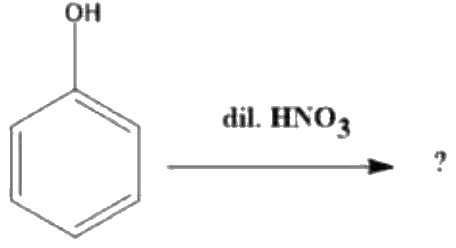
The final product(s) of the above reaction is
Answer & explanation
Correct answer: option 3
The correct answer is Option (3) → o-nitrophenol and p-nitrophenol
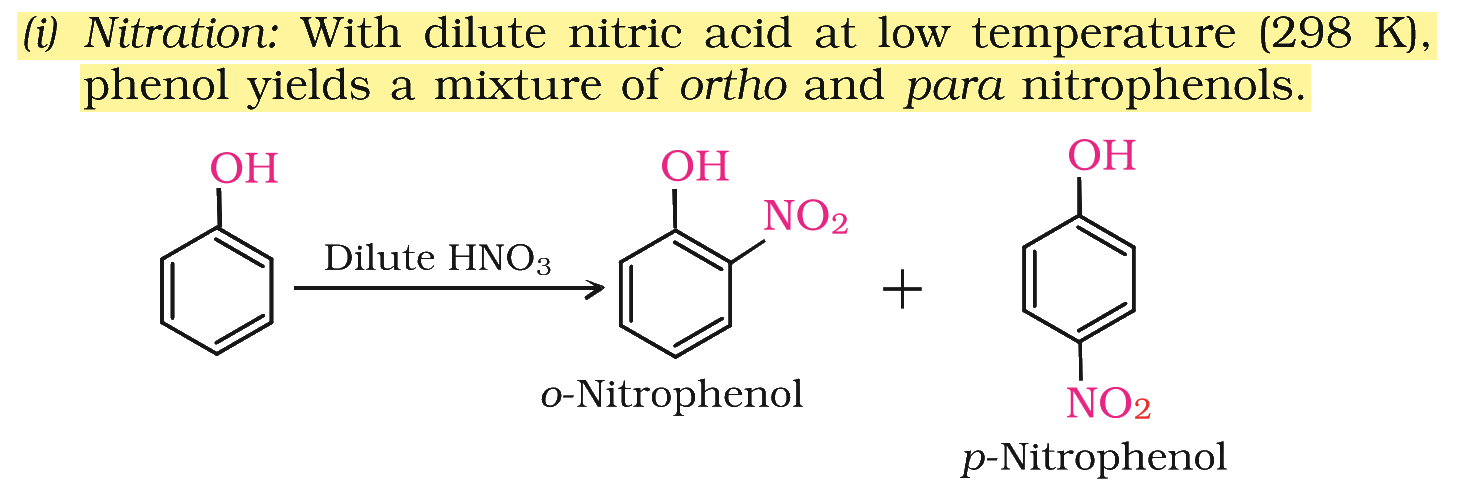
The –OH group of phenol releases electrons into the ring by resonance. It is a strongly activating, ortho and para directing group. The ring is so reactive that phenol is nitrated even by dilute nitric acid at low temperature (298 K), giving a mixture of ortho and para products:
So the final products are o-nitrophenol and p-nitrophenol.
Why the other options are incorrect
Option (1) m-nitrophenol — Incorrect. The –OH group directs to the ortho and para positions, so the meta product is not formed.
Option (2) 2,4,6-trinitrophenol (picric acid) — Incorrect. Substitution at all three positions needs concentrated nitric acid, not dilute acid.
Option (4) o-nitrophenol and m-nitrophenol — Incorrect. The meta isomer is not formed; the second product is the para isomer.
NCERT (2026-27 edition):
Nitration