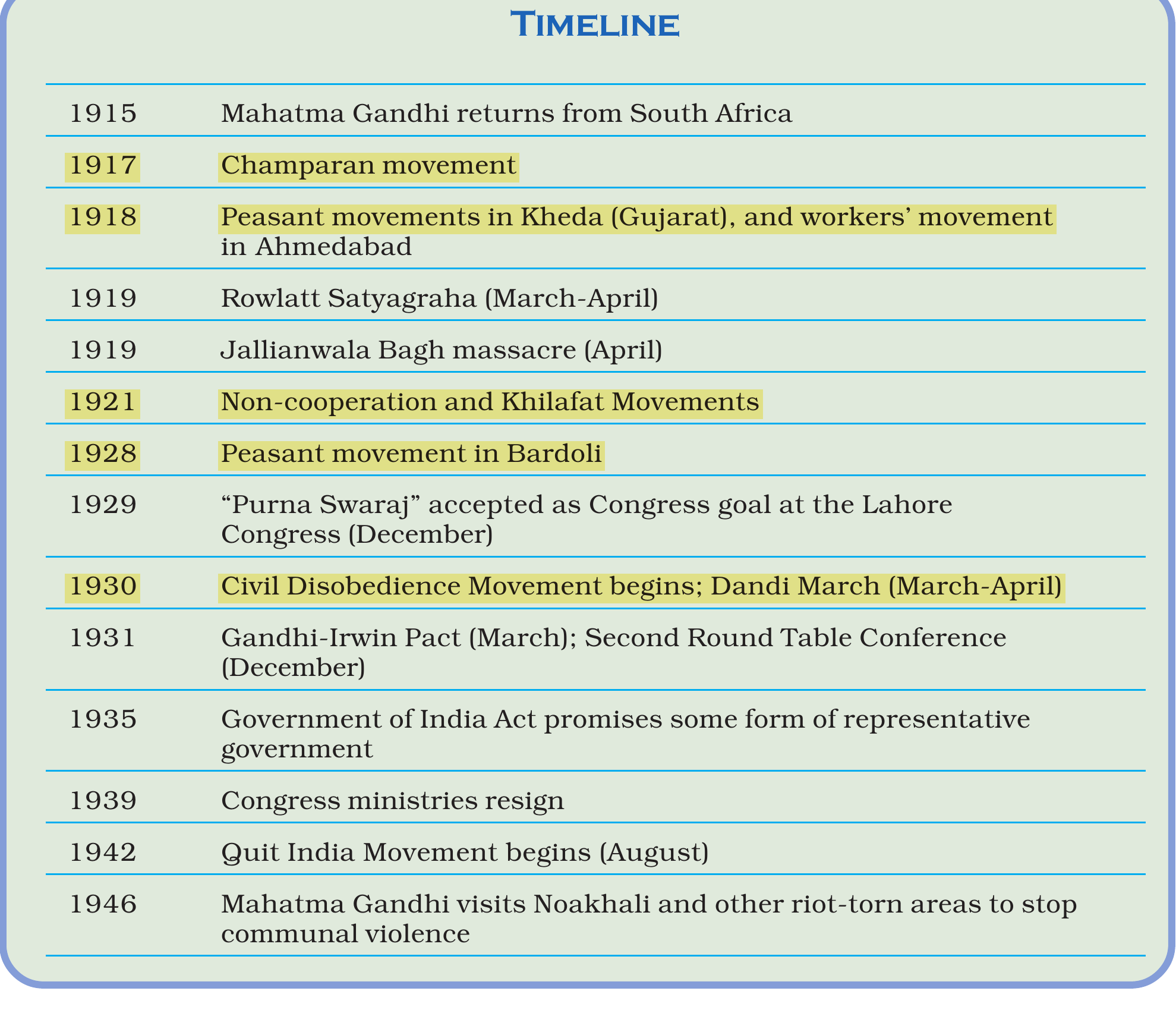
Arrange the following major movements of the Gandhian era in a chronological order.
A. Non-Cooperation Movement
B. Peasant Movement in Kheda (Gujarat)
C. Champaran Movement
D. Peasant Movement in Bardoli
E. Civil Disobedience Movement
Choose the correct answer from the options given below:
Answer & explanation
Correct answer: option 4
The correct answer is Option (4) → C, B, A, D, E
(C) Champaran Movement — 1917. Gandhiji spent much of 1917 in Champaran, seeking security of tenure for the peasants and the freedom to grow the crops of their choice.
(B) Peasant Movement in Kheda (Gujarat) — 1918. Gandhiji joined the peasants of Kheda in asking for the remission of taxes after their harvest failed.
(A) Non-Cooperation Movement — 1921, together with the Khilafat Movement.
(D) Peasant Movement in Bardoli — 1928.
(E) Civil Disobedience Movement — began in 1930, with the Dandi March (March-April).
NCERT (2026-27): “2. The Making and Unmaking of Non-cooperation … Mahatma Gandhi was to spend much of 1917 in Champaran, seeking to obtain for the peasants security of tenure as well as the freedom to cultivate the crops of their choice. The following year, 1918, Gandhiji was involved in two campaigns in his home state of Gujarat. First, he intervened in a labour dispute in Ahmedabad, demanding better working conditions for the textile mill workers. Then he joined peasants in Kheda in asking the state for the remission of taxes following the failure of their harvest.…”
|