
Which of the following are true for solutions that obey Raoult's law over the entire range of concentration?
(A) ΔmixH = 0,
(B) ΔmixV = 0
(C) They are called ideal solutions.
(D) They are called non-ideal solutions.
Choose the correct answer from the options given below:
Answer & explanation
Correct answer: option 1
The correct answer is Option (1) → (A), (B) and (C) only
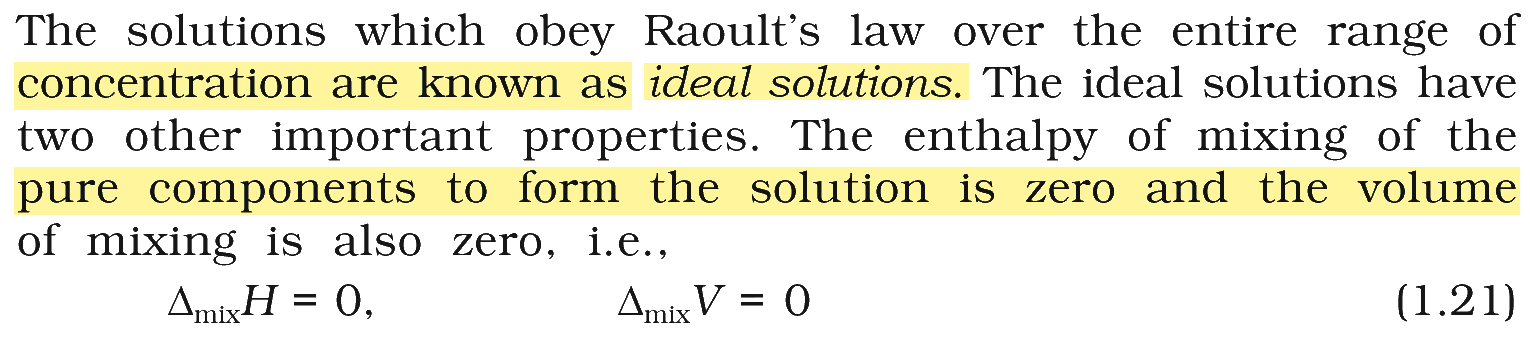
A solution that obeys Raoult’s law over the entire range of concentration is an ideal solution. The partial vapour pressure of each component is proportional to its mole fraction:
\( \displaystyle p_{\text{total}}=p_A^{\circ}x_A+p_B^{\circ}x_B \)
This happens when the A–B attractions are nearly the same as the A–A and B–B attractions, e.g. n-hexane + n-heptane, bromoethane + chloroethane, benzene + toluene.
(A) ΔmixH = 0, — Correct. Since the attractive forces do not change on mixing, no heat is absorbed or released.
(B) ΔmixV = 0 — Correct. The molecules pack the same way after mixing, so the volume of the solution equals the sum of the volumes of the components.
(C) They are called ideal solutions. — Correct. This is the definition of an ideal solution.
(D) They are called non-ideal solutions. — Incorrect. Non-ideal solutions do not obey Raoult’s law over the entire range of concentration. They show a positive deviation (e.g. ethanol + acetone) or a negative deviation (e.g. chloroform + acetone), and for them ΔmixH and ΔmixV are not zero.
NCERT (2026-27 edition):
Ideal Solutions
Non-ideal Solutions – “When a solution does not obey Raoult’s law over the entire range of concentration, then it is called non-ideal solution. …”