Read the given passage carefully and answer the next five questions.
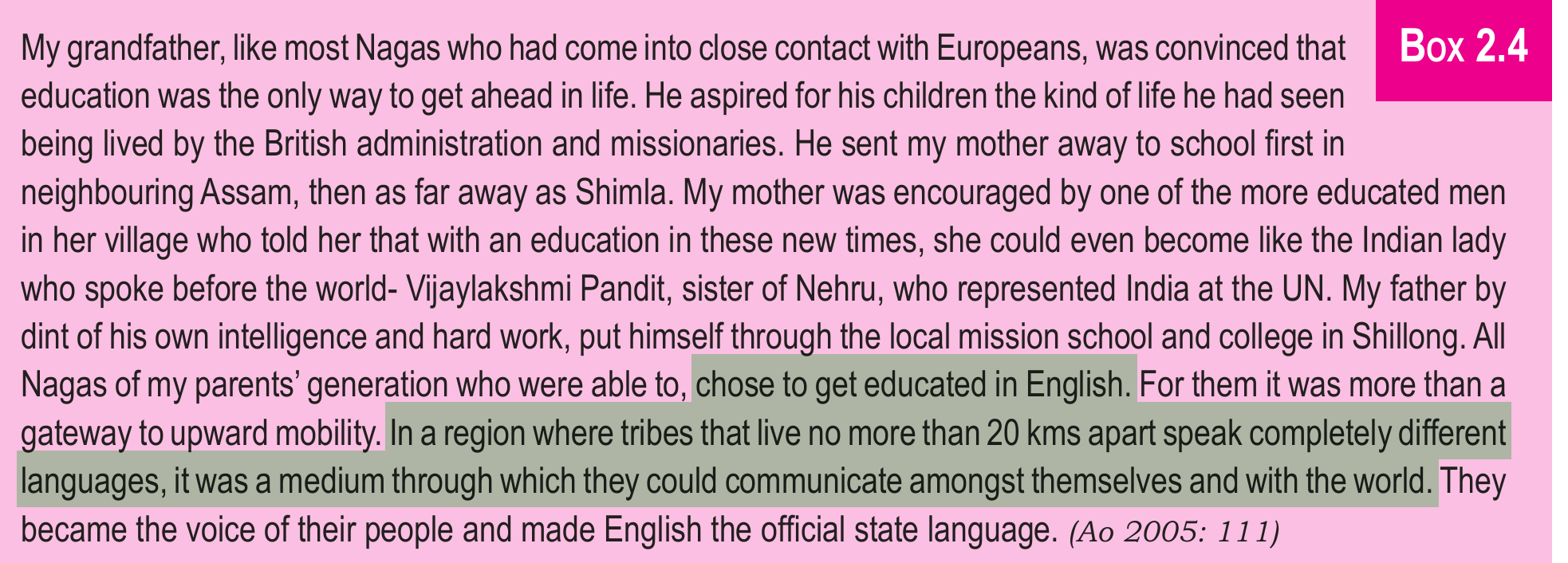
My grandfather, like most Nagas who had come into close contact with Europeans, was convinced that education was the only way to get ahead in life. He aspired for his children the kind of life he had seen being lived by the British administration and missionaries. He sent my mother away to school, first in neighbouring Assam, then as far as Shimla. My mother was encouraged by one of the more educated men in her village who told her that with an education in these new times, she could even become like the Indian lady who spoke before the world: Vijaylaxmi Pandit, who represented India at the UN. My father, by dint of his own intelligence and hard work, put himself through the local mission school and college in Shillong. All Nagas of my parents' generation who were able to, chose to get educated in English. For them, it was more than a gateway to upward mobility. In a region where tribes that live no more than 20 kms apart speak completely different languages, it was a medium through which they could communicate amongst themselves and with the world. They became the voice of their people and made English the official state language.
Which of the following is the reason for improved communication among the different factions of the Naga tribes?
Answer & explanation
Correct answer: option 1
The correct answer is Option (1) → Use of English language
Note: The passage of Q1-Q5 is Box 2.4 of the NCERT chapter ‘Cultural Change’, a Naga writer’s account (Ao 2005) that NTA reproduced almost line for line. One short box carried five questions here, so read every box of a chapter as carefully as its main text.
Option (1) Use of English language — Correct. In the Naga region, tribes living no more than 20 km apart speak completely different languages. English, which the educated Nagas of that generation chose to learn, became a medium through which they could communicate amongst themselves and with the world. It was later made the official state language.
NCERT: Social Change and Development in India — Chapter 2: Cultural Change (2025-26)
|