
Show that area of the parallelogram whose diagonals are given by $\mathbf{a}$ and $\mathbf{b}$ is $\frac{|\mathbf{a} \times \mathbf{b}|}{2}$. Also, find the area of the parallelogram, whose diagonals are $2\hat{\mathbf{i}} - \hat{\mathbf{j}} + \hat{\mathbf{k}}$ and $\hat{\mathbf{i}} + 3\hat{\mathbf{j}} - \hat{\mathbf{k}}$.
Answer & explanation
Correct answer: option 2
The correct answer is Option (2) → $\frac{\sqrt{62}}{2}$ ##
Let $ABCD$ be a parallelogram such that
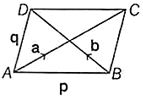
$\vec{AB} = \mathbf{p}, \vec{AD} = \mathbf{q} \Rightarrow \vec{BC} = \mathbf{q}$ [opposite side of parallelogram]
By triangle law of addition, we get
$\vec{AC} = \mathbf{p} + \mathbf{q} = \mathbf{a} \quad \text{[say]} \dots(i)$
Similarly, $\vec{BD} = -\mathbf{p} + \mathbf{q} = \mathbf{b} \quad \text{[say]} \dots(ii)$
On adding Eqs. $(i)$ and $(ii)$, we get
$\mathbf{a} + \mathbf{b} = 2\mathbf{q} \Rightarrow \mathbf{q} = \frac{1}{2}(\mathbf{a} + \mathbf{b})$
On subtracting Eq. $(ii)$ from Eq. $(i)$, we get
$\mathbf{a} - \mathbf{b} = 2\mathbf{p} \Rightarrow \mathbf{p} = \frac{1}{2}(\mathbf{a} - \mathbf{b})$
Since, area of a parallelogram $ABCD = |\mathbf{p} \times \mathbf{q}|$
Now, $\mathbf{p} \times \mathbf{q} = \frac{1}{4}(\mathbf{a} - \mathbf{b}) \times (\mathbf{a} + \mathbf{b}) \quad \left[ \mathbf{p} = \frac{1}{2}(\mathbf{a} - \mathbf{b}) \text{ and } \mathbf{q} = \frac{1}{2}(\mathbf{a} + \mathbf{b}) \right]$
$= \frac{1}{4}(\mathbf{a} \times \mathbf{a} + \mathbf{a} \times \mathbf{b} - \mathbf{b} \times \mathbf{a} - \mathbf{b} \times \mathbf{b})$
$= \frac{1}{4}[\mathbf{a} \times \mathbf{b} + \mathbf{a} \times \mathbf{b}] \quad [∵\mathbf{a} \times \mathbf{a} = 0 \text{ and } \mathbf{b} \times \mathbf{b} = 0]$
$= \frac{1}{2}(\mathbf{a} \times \mathbf{b})$
So, area of a parallelogram $ABCD = |\mathbf{p} \times \mathbf{q}| = \frac{1}{2} |\mathbf{a} \times \mathbf{b}|$
Now, area of a parallelogram, whose diagonals are $2\hat{\mathbf{i}} - \hat{\mathbf{j}} + \hat{\mathbf{k}}$ and $\hat{\mathbf{i}} + 3\hat{\mathbf{j}} - \hat{\mathbf{k}}$
$= \frac{1}{2} |(2\hat{\mathbf{i}} - \hat{\mathbf{j}} + \hat{\mathbf{k}}) \times (\hat{\mathbf{i}} + 3\hat{\mathbf{j}} - \hat{\mathbf{k}})|$
$= \frac{1}{2} \begin{vmatrix} \hat{\mathbf{i}} & \hat{\mathbf{j}} & \hat{\mathbf{k}} \\ 2 & -1 & 1 \\ 1 & 3 & -1 \end{vmatrix}$
$= \frac{1}{2} |\hat{\mathbf{i}}(1 - 3) - \hat{\mathbf{j}}(-2 - 1) + \hat{\mathbf{k}}(6 + 1)|$
$= \frac{1}{2} |-2\hat{\mathbf{i}} + 3\hat{\mathbf{j}} + 7\hat{\mathbf{k}}| = \frac{1}{2} \sqrt{4 + 9 + 49} = \frac{1}{2} \sqrt{62} \text{ sq. units}$