Which of the following is incorrect about the order of reaction?
Answer & explanation
Correct answer: option 3
The correct answer is Option (3) → The order of reaction cannot be fractional
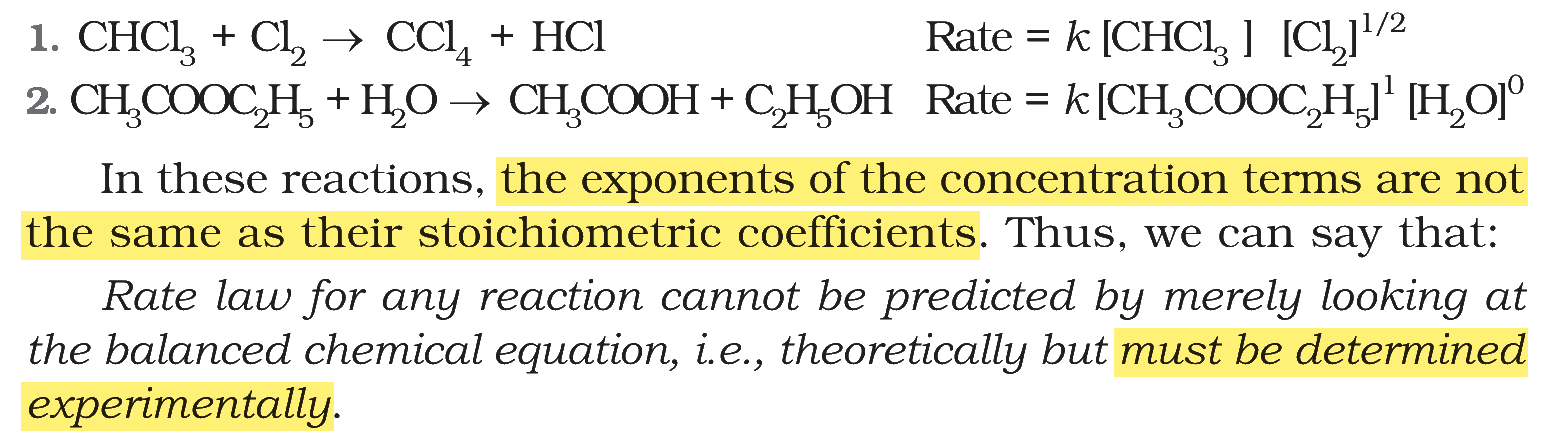
The order of a reaction is the sum of the powers of the concentration terms in its rate law. These powers are found by experiment, so the order can also be a fraction, as for the reaction of chloroform with chlorine:
\( \displaystyle \ce{CHCl3 + Cl2 -> CCl4 + HCl} \)
\( \displaystyle \text{Rate} = k\,[\ce{CHCl3}]\,[\ce{Cl2}]^{1/2} \)
\( \displaystyle \text{Order} = 1 + \frac{1}{2} = \frac{3}{2} \)
This is a fractional order, so the statement that the order cannot be fractional is incorrect.
Option (1) It is determined experimentally — Correct about the order of reaction. The rate law, and so the order, cannot be predicted from the balanced equation. It is found by measuring how the rate changes when the concentrations are changed.
Option (2) It is the sum of the powers of the concentration terms in the rate law expression — Correct about the order of reaction. This is the definition of order: x + y for Rate = k[A]x[B]y.
Option (3) The order of reaction cannot be fractional — Incorrect about the order of reaction. Order is an experimental quantity and can be a fraction, as the reaction of \( \ce{CHCl3} \) with \( \ce{Cl2} \) (order 3/2) shows. It is molecularity that must be a whole number.
Option (4) There is not necessarily a connection between order and stoichiometry of a reaction. — Correct about the order of reaction. The powers in the rate law need not match the coefficients in the equation. In the hydrolysis of ethyl acetate, water is a reactant with coefficient 1, yet its power in the rate law is 0:
\( \displaystyle \ce{CH3COOC2H5 + H2O -> CH3COOH + C2H5OH} \)
\( \displaystyle \text{Rate} = k\,[\ce{CH3COOC2H5}]^1\,[\ce{H2O}]^0 \)
NCERT (2026-27 edition):
Order of a Reaction – “… Hence,the sum of powers of the concentration of the reactants in the rate law expression is called the order of that chemical reaction. Order of a reaction can be 0, 1, 2, 3 and even a fraction.”
Molecularity of a Reaction – “(i) Order of a reaction is an experimental quantity. It can be zero and even a fraction but molecularity cannot be zero or a non integer.”
3.2.2 Rate Expression and Rate Constant