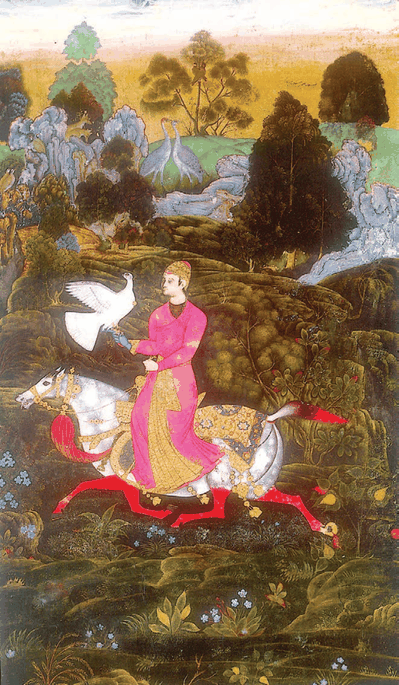
Consider the Bijapur painting Sultan Ibrahim Adil Shah II hawking. Which of the following is NOT a feature of this painting?
Answer & explanation
Correct answer: option 3
The correct answer is Option (3) → A colour schema kept largely in shades of brown and some blue
Option (1) Brilliant red on the limbs and tail of the horse and on the sultan’s flowing garment — A feature of the hawking painting. The brilliant red on the horse and the sultan’s garment leaves a lasting visual experience.
Option (2) A white hawk brought to centrestage with the delicately portrayed face of the sultan — A feature of the hawking painting. Its narrative brings the white hawk to centrestage with the sultan’s face.
Option (3) A colour schema kept largely in shades of brown and some blue — Not a feature of the hawking painting. The limited colour schema of brown and some blue belongs to the Golconda painting Composite Horse. The hawking painting is rich in red, greens, cobalt blue and a golden blue sky.
Option (4) Persian influence in the treatment of the horse and rocks — A feature of the hawking painting. Persian influence is seen in the horse and rocks; the plants in the foreground are of native inspiration.
NCERT (2026-27): “Sultan Ibrahim Adil Shah II hawking This is a painting of extraordinary energy and sensibility. The brilliant red on the limbs and tail of the horse, and the flowing garment of Sultan Ibrahim Adil Shah II render a visual experience, which remains with one. Besides, the dark dense forest foliage, deep olive green, emerald green and cobalt blue with cranes in the background and sunlit golden blue sky enhance the experience of the painting and its narrative, which brings the white hawk to the centrestage along with the delicately portrayed face of the sultan. Persian influence is evident in the treatment of the horse and rocks…”
“Composite Horse …All actions happen within limited colour schema, which remains largely in the shades of brown and some blue.…” |