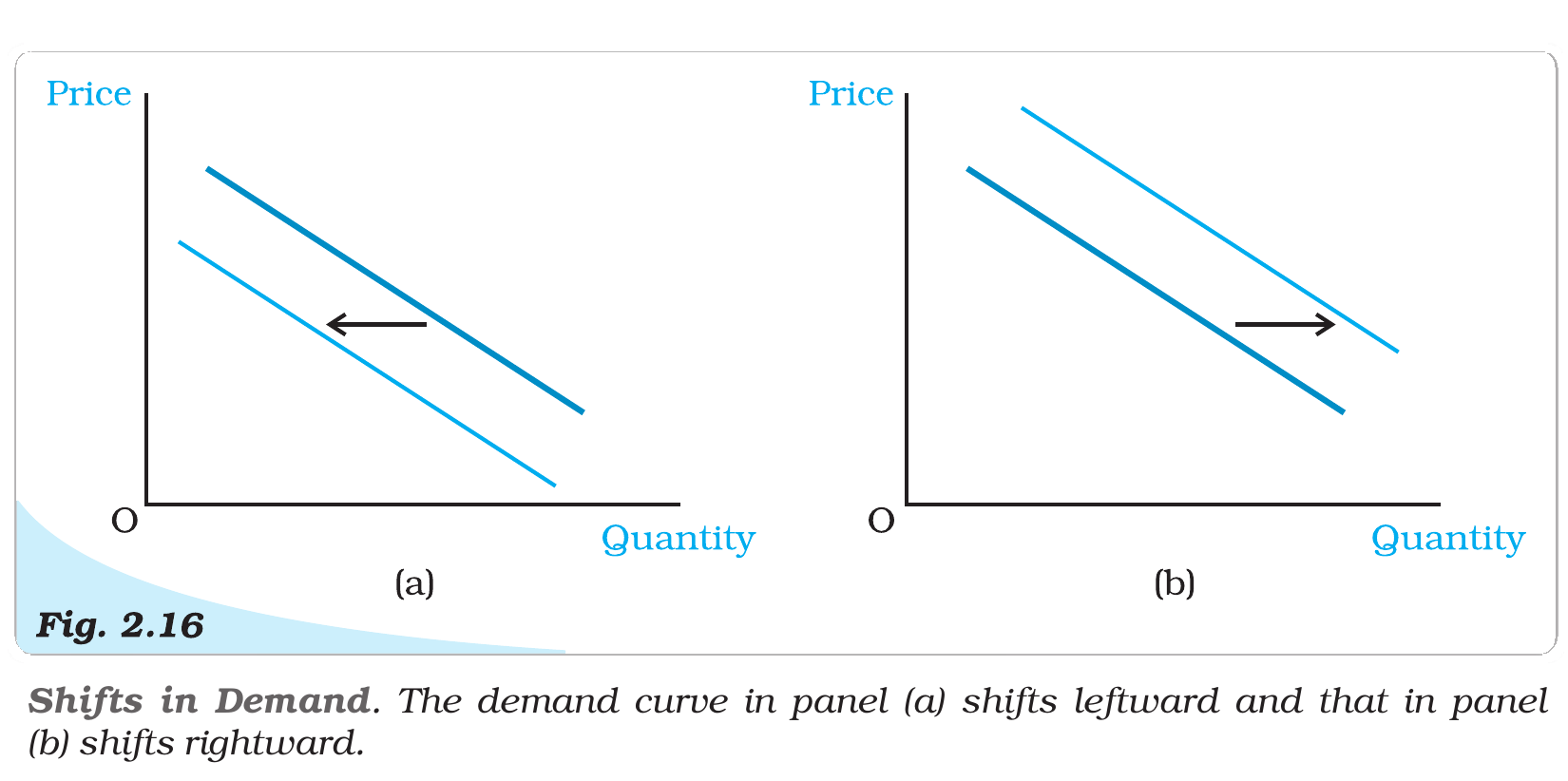
Identify the reason for a rightward shift in the demand curve of a normal good.
Answer & explanation
Correct answer: option 1
The correct answer is Option (1) → Increase in income of consumer
A demand curve shifts when something other than the good’s own price changes. A normal good is one whose demand rises when income rises, so its curve moves to the right.
Option (1) Increase in income of consumer — Correct. With more income, the consumer buys more of the good at each price. That is a rightward shift.
Option (2) Increase in the price of the good — Incorrect. A change in the good’s own price is a movement along the same curve. The quantity demanded falls, and the curve stays where it is.
Option (3) Decrease in the price of the good — Incorrect. This too is a movement along the same curve. The quantity demanded rises, and the curve does not shift.
Option (4) No change in the price — Incorrect. With no other change, the consumer stays at the same point on the curve.
NCERT (2026-27): “2.4.5 Shifts in the Demand Curve … The demand curve was drawn under the assumption that the consumer’s income, the prices of other goods and the preferences of the consumer are given. … Given the prices of other goods and the preferences of a consumer, if the income increases, the demand for the good at each price changes, and hence, there is a shift in the demand curve. For normal goods, the demand curve shifts rightward and for inferior goods, the demand curve shifts leftward.… Shifts in the demand curve are depicted in Figure 2.16. It may be mentioned that shift in demand curve takes place when there is a change in some factor, other than the price of the commodity. 2.4.6 Movements along the Demand Curve and Shifts in the Demand Curve …The demand function is a relation between the amount of the good and its price when other things remain unchanged. The demand curve is a graphical representation of the demand function. At higher prices, the demand is less, and at lower prices, the demand is more. Thus, any change in the price leads to movements along the demand curve.…”
|