Select the reagents a and b respectively, used in the Hell-Volhard-Zelinsky reaction:
\( \ce{R-CH2COOH} \xrightarrow[\mathrm{b}]{\mathrm{a}} \ce{R-CH(X)-COOH} \)
X = Cl, Br
A. X2
B. X2/Red Phosphorus
C. H2O
D. SOCl2
E. X2/Yellow Phosphorus
Choose the correct answer from the options given below:
Answer & explanation
Correct answer: option 2
The correct answer is Option (2) → B and C only
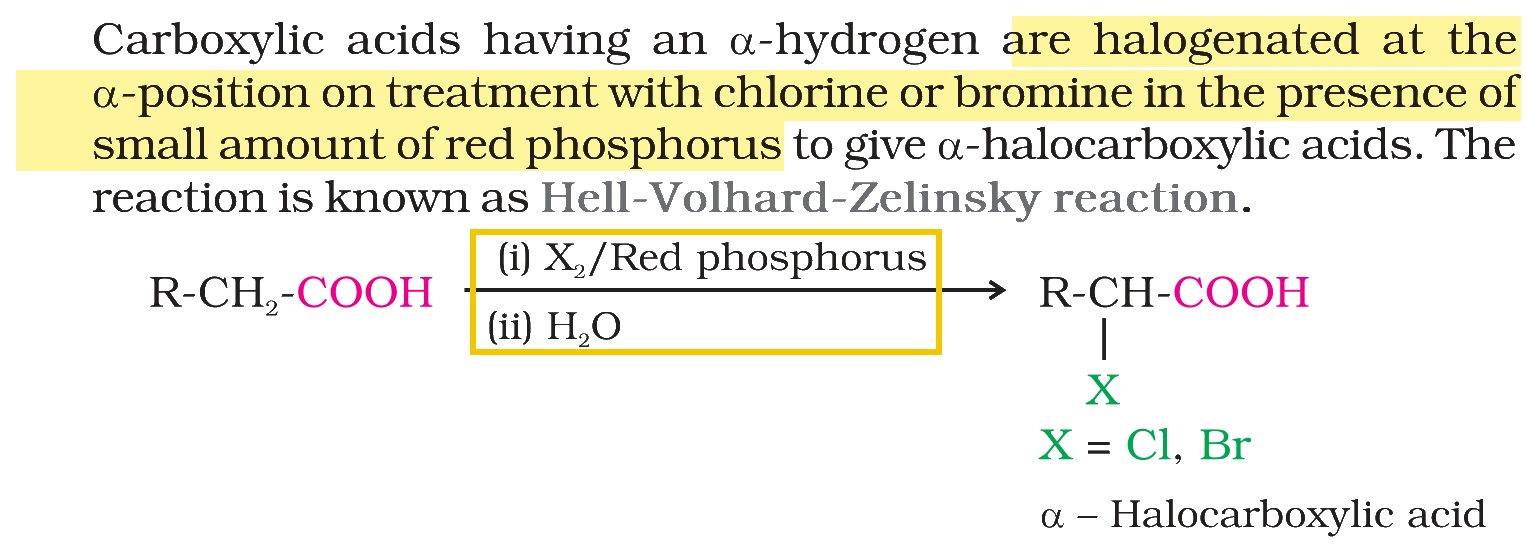
In the Hell-Volhard-Zelinsky (HVZ) reaction, a carboxylic acid having an α-hydrogen is halogenated at the α-position by chlorine or bromine in the presence of a small amount of red phosphorus; the product is then treated with water to give the α-halocarboxylic acid:
\( \displaystyle \ce{R-CH2-COOH} \xrightarrow[\text{(ii) }\ce{H2O}]{\text{(i) }\ce{X2}/\text{red P}} \ce{R-CH(X)-COOH}\qquad (\mathrm{X} = \mathrm{Cl,\ Br}) \)
(A) \( \ce{X2} \) — Incorrect. The halogen alone does not halogenate the α-carbon of the acid; red phosphorus is needed (it forms \( \ce{PX3} \) and the acyl halide, whose enol is halogenated).
(B) \( \ce{X2} \)/Red Phosphorus — Correct. This is reagent a: the halogen together with a small amount of red phosphorus brings the halogen onto the α-carbon.
(C) \( \ce{H2O} \) — Correct. This is reagent b; it hydrolyses the α-haloacyl halide to the α-halo acid.
(D) \( \ce{SOCl2} \) — Incorrect. Thionyl chloride converts −COOH into −COCl; it does not introduce a halogen at the α-carbon.
(E) \( \ce{X2} \)/Yellow Phosphorus — Incorrect. The HVZ reaction uses red phosphorus; yellow (white) phosphorus is dangerously reactive and is not the reagent named for it.
NCERT (2026-27 edition):
Halogenation