Statements about art in India up to the nationalist period.
(A) Before the British, art in India could be seen as temple-wall statues and decorated village mud-house walls.
(B) In Tiller of the Soil, Nandalal Bose used a folk style on purpose to represent rural life.
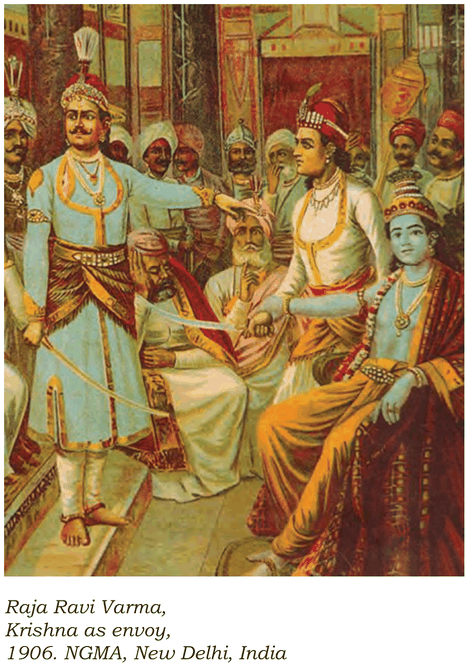
(C) Krishna as envoy was painted by Raja Ravi Varma.
(D) Painters of the Company School relied more on memory and rule books than on close observation.
How many of the statements given above are correct?
Answer & explanation
Correct answer: option 3
The correct answer is Option (3) → Three
(A) Before the coming of the British, art in India could be seen as statues on temple walls and decoration on the walls of mud houses in villages. — Correct. Art was seen in statues on temple walls, manuscript miniatures and the walls of mud houses.
(B) In Tiller of the Soil, Nandalal Bose used a folk style on purpose to represent rural life. — Correct. In this Haripura panel the folk style is purposely used to represent the rural life and Gandhi’s idea of the village.
(C) Krishna as envoy was painted by Raja Ravi Varma. — Correct. It is a work of Raja Ravi Varma of the Travancore Court.
(D) Painters of the Company School relied more on memory and rule books than on close observation. — Incorrect. It is the other way round. They relied more on close observation, a feature of European art, rather than memory and rule books.
Note: This topic was not named in the CUET 2026 syllabus, but it was part of the NCERT chapter. In 2025 and 2026, NTA also asked questions on topics in NCERT that the CUET syllabus did not name. So our mocks have questions from every part of the NCERT chapter, to give you enough practice. Read the whole chapter, not only the sub-topics named in the syllabus.
NCERT (2026-27): “Company Painting Art in India had a different purpose prior to the coming of the British. It could be seen as statues on temple walls, miniature paintings that often illustrated manuscripts, decoration on the walls of mud houses in villages, among many other examples.…To please their new patrons, they had to adapt their traditional way of painting to document the world around them. This meant that they had to rely more on close observation, a striking feature of the European art, rather than memory and rule books, as seen in traditional art.…” “Tiller of the Soil This is one of the panels made by Nandalal Bose in 1938 for the Haripura Congress.…He used thick tempera in a bold cursory style and broad brushwork. This technique and style was reminiscent of the folk art practice of patuas or scroll painters. Folk style is purposely used to represent the rural life. It also conveys political statement of Gandhi’s idea of village.…”
|