
Match List-I with List-II.
| List-I | List-II |
| Complex | Magnetic moment |
| (A) K[Cr(H2O)2(C2O4)2]·3H2O | (p) 1.73 BM |
| (B) K4[Mn(CN)6] | (q) 5.92 BM |
| (C) [Co(NH3)5Cl]Cl2 | (r) 3.87 BM |
| (D) Cs[FeCl4] | (s) Zero |
Choose the correct answer from the options given below:
Answer & explanation
Correct answer: option 1
The correct answer is Option (1) → A-r, B-p, C-s, D-q
The spin-only magnetic moment depends only on the number of unpaired electrons n:
\( \displaystyle \mu=\sqrt{n(n+2)}\,\mathrm{BM} \)
To find n, get the oxidation state of the metal from the charges, derive the d electron count from Z, and then place the electrons using crystal field theory.
A strong field ligand (\( \ce{CN^-} \), and \( \ce{NH3} \) with \( \ce{Co^3+} \)) makes the electrons pair in the lower t2g set (low spin). A weak field ligand (\( \ce{Cl^-} \), \( \ce{H2O} \)) leaves them unpaired (high spin).
In tetrahedral complexes the splitting is small, so pairing is not forced and they are high spin.
(A) K[Cr(H2O)2(C2O4)2]·3H2O — This matches (r) 3.87 BM.
Oxidation state: charge balance: +1 + x + 2(0) + 2(−2) = 0, so x = +3.
Configuration: Chromium (Z = 24) is [Ar]3d54s1; losing the 4s electron and two 3d electrons gives \( \ce{Cr^3+} \): 3d3.
Result: the three electrons occupy the three t2g orbitals singly whatever the ligand, so n = 3.
\( \displaystyle \mu=\sqrt{3(3+2)}=\sqrt{15}=3.87\,\mathrm{BM} \)
(B) K4[Mn(CN)6] — This matches (p) 1.73 BM.
Oxidation state: charge balance: 4(+1) + x + 6(−1) = 0, so x = +2.
Configuration: Manganese (Z = 25) is [Ar]3d54s2; losing the two 4s electrons gives \( \ce{Mn^2+} \): 3d5.
Result: cyanide is a strong field ligand, so all five electrons go into t2g (t2g5), leaving n = 1.
\( \displaystyle \mu=\sqrt{1(1+2)}=\sqrt{3}=1.73\,\mathrm{BM} \)
(C) [Co(NH3)5Cl]Cl2 — This matches (s) Zero.
Oxidation state: charge balance: x + 5(0) + (−1) + 2(−1) = 0, so x = +3.
Configuration: Cobalt (Z = 27) is [Ar]3d74s2; losing the two 4s electrons and one 3d electron gives \( \ce{Co^3+} \): 3d6.
Result: ammonia acts as a strong field ligand towards \( \ce{Co^3+} \), so all six electrons pair in t2g (t2g6), n = 0, and the complex is diamagnetic.
\( \displaystyle \mu=\sqrt{0(0+2)}=0 \)
(D) Cs[FeCl4] — This matches (q) 5.92 BM.
Oxidation state: charge balance: +1 + x + 4(−1) = 0, so x = +3.
Configuration: Iron (Z = 26) is [Ar]3d64s2; losing the two 4s electrons and one 3d electron gives \( \ce{Fe^3+} \): 3d5.
Result: \( \ce{[FeCl4]^-} \) is tetrahedral with the weak field ligand \( \ce{Cl^-} \), so it is high spin and all five electrons stay unpaired, n = 5.
\( \displaystyle \mu=\sqrt{5(5+2)}=\sqrt{35}=5.92\,\mathrm{BM} \)
NCERT (2026-27 edition):
4.3.9 Magnetic Properties – “… For these, the magnetic moment is determined by the number of unpaired electrons and is calculated by using the ‘spin-only’ formula, i.e., \( \mu=\sqrt{n(n+2)} \) where n is the number of unpaired electrons and μ is the magnetic moment in units of Bohr magneton (BM). A single unpaired electron has a magnetic moment of 1.73 Bohr magnetons (BM).”
5.5.4 Crystal Field Theory – “… In general, ligands can be arranged in a series in the order of increasing field strength as given below: I– < Br– < SCN– < Cl– < S2– < F– < OH– < C2O42– < H2O < NCS– < edta4– < NH3 < en < CN– < CO Such a series is termed as spectrochemical series. … In d2 and d3 coordination entities, the d electrons occupy the t2g orbitals singly in accordance with the Hund’s rule. … (i) If Δo < P, the fourth electron enters one of the eg orbitals giving the configuration t2g3 eg1. Ligands for which Δo < P are known as weak field ligands and form high spin complexes. (ii) If Δo > P, it becomes more energetically favourable for the fourth electron to occupy a t2g orbital with configuration t2g4eg0. Ligands which produce this effect are known as strong field ligands and form low spin complexes.”
5.5.1 Valence Bond Theory – “In the diamagnetic octahedral complex, [Co(NH3)6]3+, the cobalt ion is in +3 oxidation state and has the electronic configuration 3d6.”
(b) Crystal field splitting in tetrahedral coordination entities – “… Consequently, the orbital splitting energies are not sufficiently large for forcing pairing and, therefore, low spin configurations are rarely observed.”
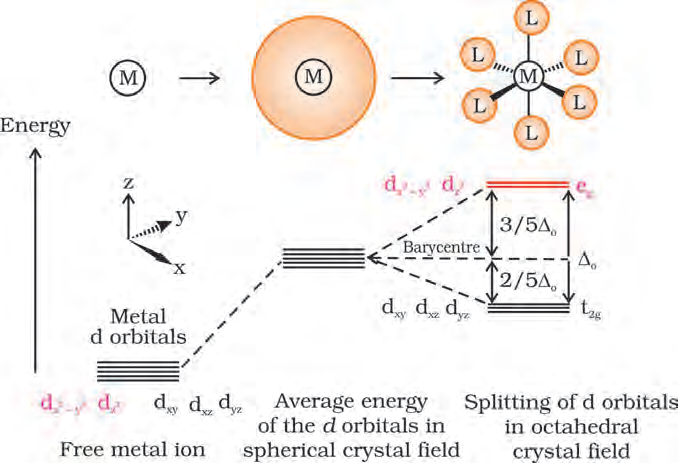
Fig. 5.8: d orbital splitting in an octahedral crystal field