
CUETMOCK
  • Pricing
  • Mentors
Log inStart freeStart free mocks→

First test, then trust

Try a free CUET mock test.

Join 5,00,000+ students who rehearsed exam day on the exact NTA screen before sitting CUET. On the web and on Android.

Start free mocks →Get the Android app
CUETMOCK

India's #1 CUET Mock Test Platform. Original NCERT-based questions on the exact NTA exam screen — trusted by 5,00,000+ students since CUET 2022.

Get it onGoogle PlayScan to download the CUETMOCK app

Mock tests

  • CUET mock test series
  • Browse all papers
  • Commerce mocks
  • Humanities (Arts) mocks
  • Science mocks
  • Languages & GAT mocks
  • Free practice questions
  • Pricing

Resources

  • CUET exam guide
  • CUET syllabus
  • Universities accepting CUET
  • Expert blogs
  • News & notifications
  • Webinars & counselling
  • CUET score calculator
  • How we estimate your rank
  • FAQs

Company

  • About us
  • Our leadership & team
  • Our toppers
  • Mentors
  • For schools
  • Contact us
  • Terms
  • Privacy
  • Refund policy

Talk to us

+91 7696 6630 56info@cuetmock.comWhatsApp us

Our other platforms

  • JEE Mock — For IIT-JEE aspirants
  • NEET Mock — For NEET aspirants

Newsletter

Exam updates, study material and offers — no spam.

© 2026 NYC Ventures Pvt. Ltd.

701-702, Royal Business Park, Zirakpur, Punjab - 140603

  • Terms of use
  • Privacy policy
  • Refund policy
  • Contact us

iCUETMOCK is an independent preparation platform, not affiliated with the National Testing Agency (NTA). Always check exam details on the official NTA website.

  • Home
  • Mock tests
  • CUET guide
  • Pricing
  • Log in
Home/Practice questions/Chemistry
ChemistryOrganic: Haloalkanes and Haloarenes

Friedel-Craft reaction as shown below is an example of
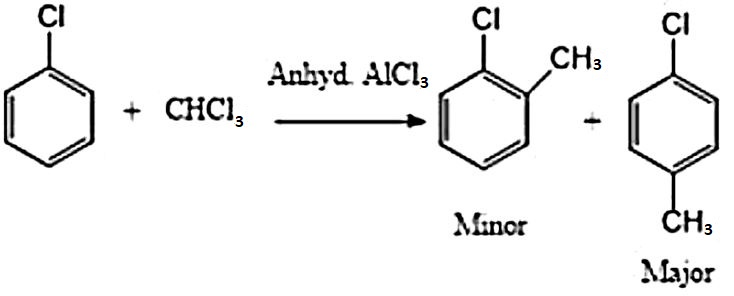
Friedel-Craft reaction as shown below is an example of

Figure for Q36

Answer & explanation+

Correct answer: option 1

The correct answer is Option (1) → Electrophilic substitution reaction

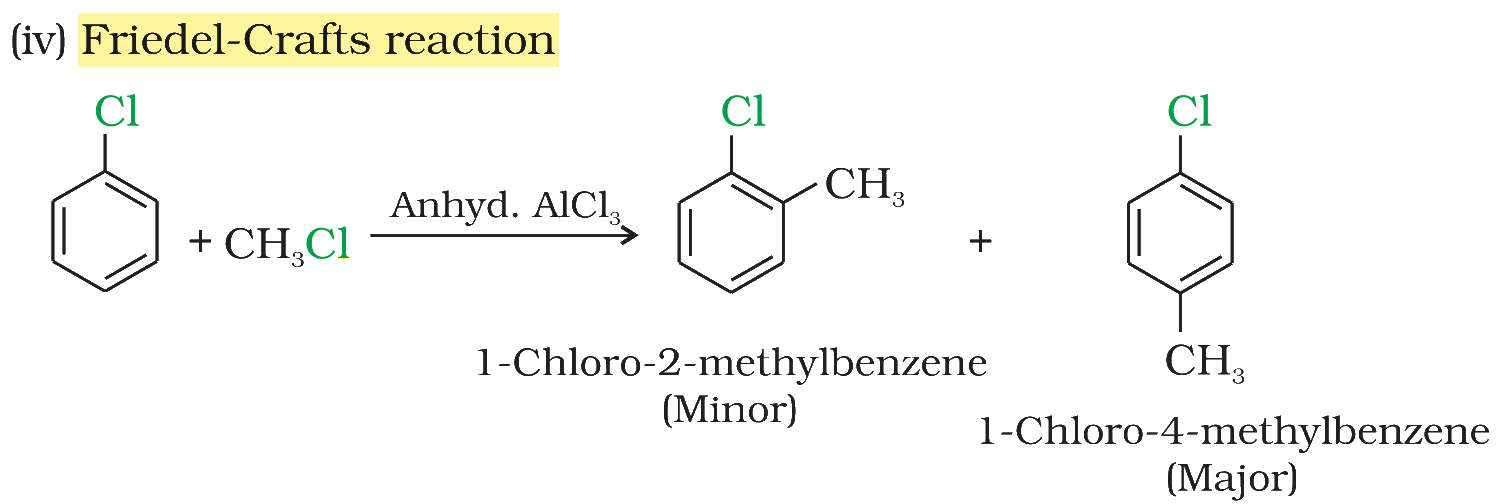
In a Friedel-Crafts alkylation, anhydrous \( \ce{AlCl3} \), a Lewis acid, pulls the chlorine away from the alkyl halide and produces an electrophile, here the methyl cation from methyl chloride:

    \( \displaystyle \ce{CH3Cl + AlCl3 -> CH3^+ + AlCl4^-} \)

The electrophile attacks the benzene ring of chlorobenzene and a hydrogen of the ring is lost as \( \ce{H+} \), which regenerates the catalyst (\( \ce{H+ + AlCl4^- -> HCl + AlCl3} \)). A ring hydrogen is replaced by the methyl group and the aromatic ring is kept, so this is electrophilic substitution:

    \( \displaystyle \ce{C6H5Cl + CH3Cl} \xrightarrow{\text{anhyd. }\ce{AlCl3}} \text{1-chloro-2-methylbenzene (minor)} + \text{1-chloro-4-methylbenzene (major)} + \ce{HCl} \)

Chlorine deactivates the ring slightly, but its lone pairs direct the electrophile to the ortho and para positions; the para product is major because the ortho positions are crowded by the chlorine atom.

Why the other options are incorrect

  • Option (2) Nucleophilic substitution reaction — Incorrect. In this type a nucleophile replaces the halogen, e.g. chlorobenzene with NaOH at 623 K and 300 atm gives phenol. Here the chlorine stays on the ring and an electrophile replaces a hydrogen.

  • Option (3) Electrophilic addition reaction — Incorrect. This is typical of alkenes, e.g. \( \ce{CH2=CH2 + HBr -> CH3CH2Br} \). The benzene ring does not add the reagent; it keeps its aromatic sextet by losing \( \ce{H+} \).

  • Option (4) Nucleophilic addition reaction — Incorrect. This is typical of aldehydes and ketones, e.g. the addition of HCN to the C=O group; there is no carbonyl group here.

Note: It seems that there is a mistake in the original NTA paper. The reagent in the reaction is printed as \( \ce{CHCl3} \) (chloroform); it should be \( \ce{CH3Cl} \) (methyl chloride), since only methyl chloride gives 1-chloro-2-methylbenzene and 1-chloro-4-methylbenzene.

NCERT (2026-27 edition):
Electrophilic Substitution Reactions – “Haloarenes undergo the usual electrophilic reactions of the benzene ring such as halogenation, nitration, sulphonation and Friedel-Crafts reactions. Halogen atom besides being slightly deactivating is o, p- directing; therefore, further substitution occurs at ortho- and para- positions with respect to the halogen atom.”

Friedel-Crafts Reaction
Textbook extract

Advertisement

Practise more on Organic: Haloalkanes and Haloarenes

Chapter-wise mocks on the real NTA exam screen, with solutions and your rank. Your first mocks are free.

Start free mocks →

Advertisement

Next questions

  1. If A= […] and A^2-3A+kI=0 then the value of k is:Maths. Section B1 · Matrices
  2. Heart' is related to 'Blood' in the same way as 'lung' is related to which of the following?General Aptitude Test · General Ability
  3. Prior to Independence stagnation in the Agricultural sector of India was caused mainly due to :Economics · Indian Economic Development: Indian Economy on the Eve of Independence
  4. Select the sentences that contains no spelling errors.English · Spelling Check
  5. For a reaction A → C+D , the initial concentration of A is 0.010 M. After 100 sec, the conc. of A is 0.001 M. The rate constant has numeric…Chemistry · Physical: Chemical Kinetics
  6. Who was known as Frontier Gandhi?Political Science · Politics in India Since Independence: Challenges of nation Building
  7. If a_ij and A_ij represents the elements and cofactors of the matrix A= […] then which of the following statements are True?(A) |A| = 28(B)…Applied Maths. Section A · Determinants (Section A)
  8. Which of the following main types of iron ores are found in India?Geography · India-People and Economy: Mineral and Energy resources
  9. Rs.3600 is distributed between A, B, and C in the proportions 3 : 4 : 5 . The difference of share of A & C is ?General Aptitude Test · Numerical Ability
  10. Maths. Section B1 · Vectors