
Arrange the following compounds in increasing order of their acidic strength?
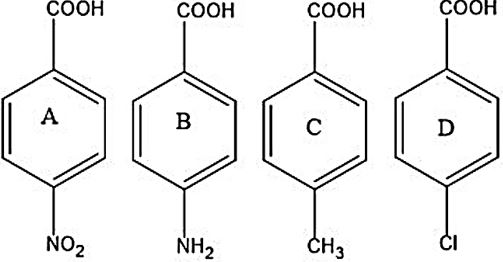
Choose the correct answer from the options given below:
Answer & explanation
Correct answer: option 1
The correct answer is Option (1) → (C), (B), (D), (A)
Core Concept
Acidity of substituted benzoic acids depends on the electron-withdrawing or electron-donating nature of substituents.
Electron-withdrawing groups increase acidity by stabilizing the carboxylate ion.
Electron-donating groups decrease acidity by destabilizing the carboxylate ion.
Explanation
(A) p-NO₂ (Strong Electron Withdrawing Group)
NO₂ shows strong –I and –R effect.
It stabilizes the carboxylate ion significantly.
Hence, it increases acidity the most.
(B) p-NH₂ (Strong Electron Donating Group)
NH₂ shows +R effect.
It pushes electron density towards the ring.
This destabilizes the carboxylate ion.
Hence, least acidic.
(C) p-CH₃ (Weak Electron Donating Group)
CH₃ shows +I effect.
It slightly donates electron density.
So acidity decreases but less than NH₂.
(D) p-Cl (Electron Withdrawing by –I, donating by +R)
Net effect is electron withdrawing due to strong –I.
So acidity increases but less than NO₂.