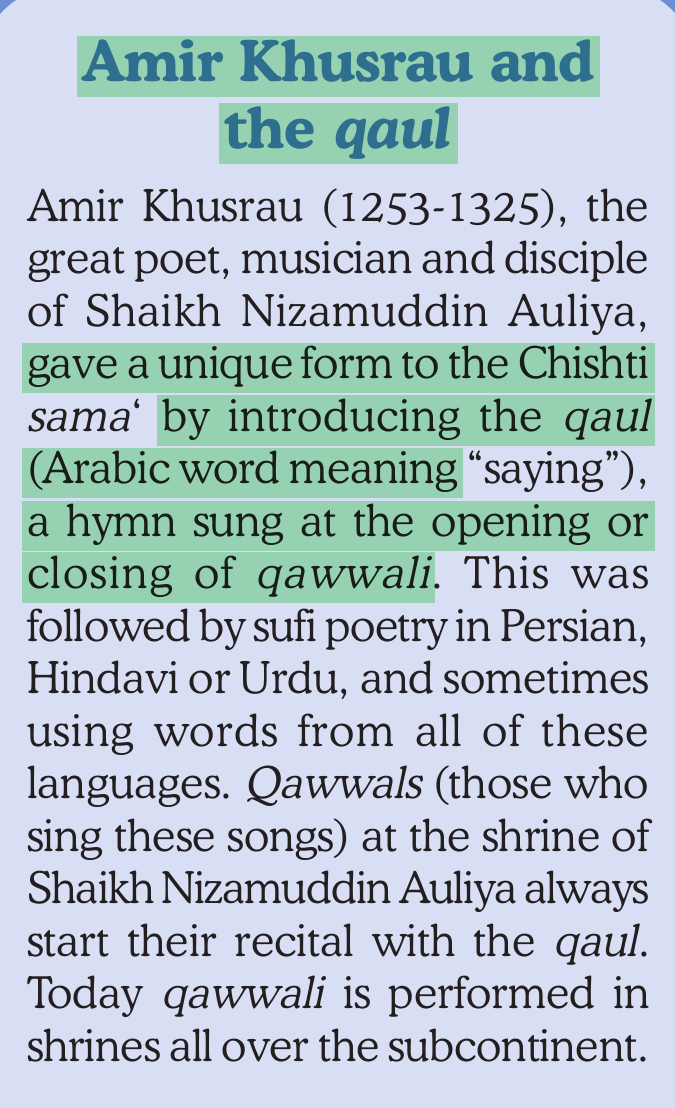
Amir Khusrau, the great poet and musician, gave a unique form to the Chishti sama by introducing _____.
Answer & explanation
Correct answer: option 3
The correct answer is Option (3) → Qaul
Option (1) Zikr — Incorrect. The zikr is the recitation of the Divine Names, one of the two ways in which sufis call God to mind; the other is sama‘, mystical music. It was a sufi practice long before Amir Khusrau, not a form he introduced into the sama‘.
Option (2) Auqaf — Incorrect. Auqaf were charitable trusts that the Sultans set up as endowments for sufi hospices. They were grants of the state, not a part of music or song.
Option (3) Qaul — Correct. Amir Khusrau, poet, musician and disciple of Shaikh Nizamuddin Auliya, introduced the qaul (Arabic for “saying”), a hymn sung at the opening or closing of qawwali.
Option (4) Barkat — Incorrect. Barakat is the Grace of God, which a wali (friend of God) claimed to acquire in order to perform miracles. It is a spiritual quality, not a form of song.
NCERT (2026-27): “7.2 Chishti devotionalism: ziyarat and qawwali … Also part of ziyarat is the use of music and dance including mystical chants performed by specially trained musicians or qawwals to evoke divine ecstasy. The sufis remember God either by reciting the zikr (the Divine Names) or evoking His Presence through sama‘ (literally, ‘audition’) or performance of mystical music. Sama‘ was integral to the Chishtis, and exemplified interaction with indigenous devotional traditions.…”
|