
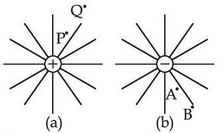
For the given field lines for a positive and a negative point charge respectively, which of the following is correct?
Answer & explanation
Correct answer: option 1
The correct answer is Option (1) → \( (V_P-V_Q) \) is positive and work done by the external agency in moving a small negative charge from B to A is positive.
The potential falls along the direction of the electric field, and the work done by an external agent in moving a test charge q between two points is \( W = q(V_{\mathrm{final}} - V_{\mathrm{initial}}) \), taken to be done slowly.
Positive charge, figure (a): the field points away from the charge and P is closer to it than Q, so
\( V_P \gt V_Q \Rightarrow V_P - V_Q \) is positive
Negative charge, figure (b): the field points towards the charge, so the potential rises outwards; B is farther out than A, so
\( V_B \gt V_A \Rightarrow V_B - V_A \) is positive
Work done in moving a small negative charge from B to A
\( W = q(V_A - V_B) = (-)(-) = + \)
The work is positive: the small negative charge is repelled by the negative source charge, so the agent must push it in to A. Both parts of Option (1) are true. In Options (2) and (4) the work in moving a positive charge from Q to P is \( q(V_P - V_Q) \), which is positive, not negative, and Options (3) and (4) wrongly say \( V_P - V_Q \) or \( V_B - V_A \) is negative.