Match List-I with List-II (TP: TOTAL PRODUCT; L: UNITS OF LABOUR)
| List-I | List-II |
| (A) \( TP/L \) | (I) Total Product is maximum |
| (B) \( ΔTP/ΔL \) | (II) Marginal product |
| (C) \( ∑MP \) | (III) Total product |
| (D) \( MP=0 \) | (IV) Average Product |
Choose the correct answer from the options given below:
Answer & explanation
Correct answer: option 3
The correct answer is Option (3) → (A)-(IV), (B)-(II), (C)-(III), (D)-(I)
Total product (TP) is the output from a given number of units of labour. The other two measures come from it: one is the output per unit, and the other is the output added by one more unit.
| List-I | List-II | Reason |
|---|---|---|
| (A) \( TP/L \) | (IV) Average Product | Average product is output per unit of labour. |
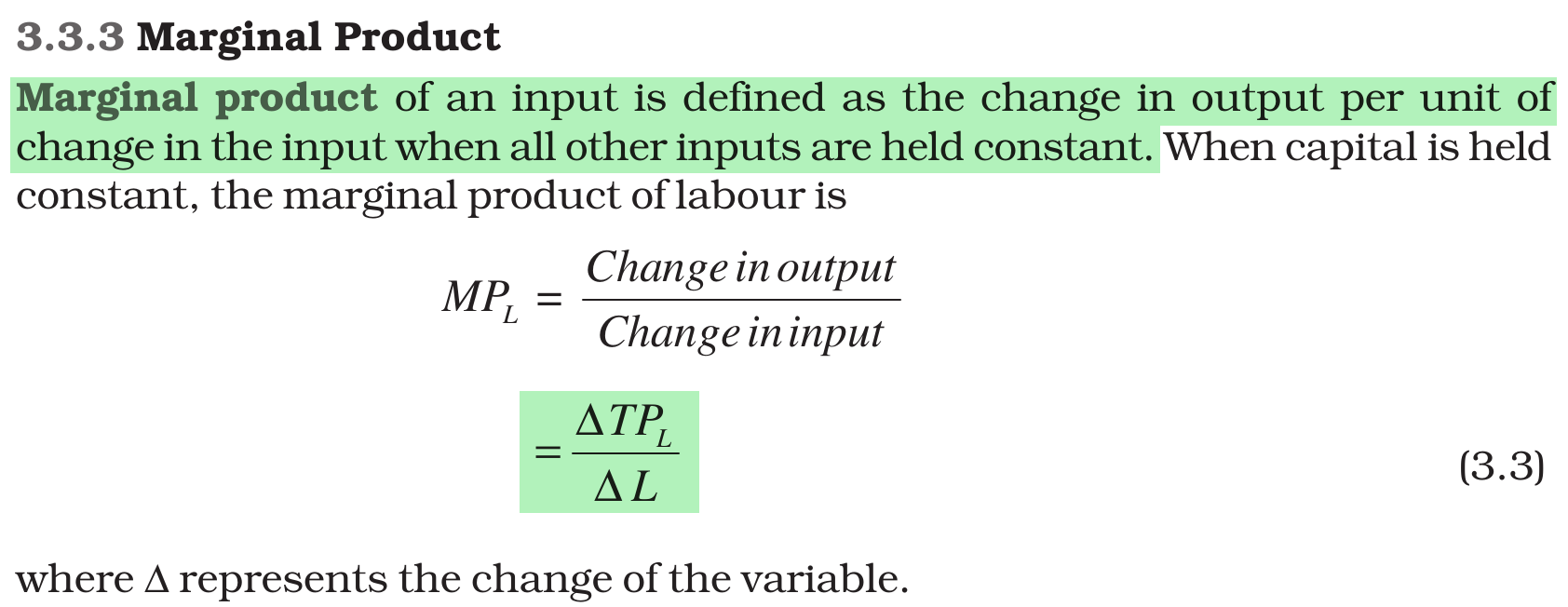
| (B) \( ΔTP/ΔL \) | (II) Marginal product | Marginal product (MP) is the change in TP per unit change in labour. |
| (C) \( ∑MP \) | (III) Total product | Adding the marginal products of all the units up to a level gives the total product. |
| (D) \( MP=0 \) | (I) Total Product is maximum | While MP is positive, TP keeps rising. When MP is zero, TP stops rising, so it is at its highest. |
NCERT (2026-27): Introductory Microeconomics — Chapter 3: Production and Costs
|