
Read the passage and answer the following question:
In 1963, enzymes that restricted the growth of bacteriophage in Escherichia coli were discovered. Among them, restriction endonucleases played a vital role. Five years later, Hind II, the first restriction endonuclease, was isolated and characterized. Hind II was known for its ability to cut DNA molecules at a specific point by recognizing a unique six-base pair sequence, which was termed the "recognition sequence" for Hind II. Currently, over 900 restriction enzymes have been identified from more than 230 bacterial strains, each recognizing different recognition sequences. For example, EcoRI is derived from Escherichia coli RY 13, where the letter 'R' represents the name of the strain, and the Roman numeral indicates the order of enzyme isolation from that strain. Restriction enzymes belong to a larger class of enzymes that can be divided into two types: exonucleases and endonucleases. Exonucleases remove nucleotides from the ends of DNA, while endonucleases make cuts at specific positions within the DNA. Each restriction endonuclease "inspects" the length of a DNA sequence until it finds its specific recognition sequence. Once located, it binds to the DNA and cuts both strands of the double helix at specific points in their sugar-phosphate backbones. Notably, each restriction endonuclease recognizes a specific palindromic nucleotide sequence in the DNA.
Given below are two statements:
Statement I: Restriction enzymes cut the strand of DNA a little away from the centre of the palindrome sites, but between the same two bases on the opposite strands.
Statement II: The overhanging stretches left at the cut ends are called sticky ends because they form phosphodiester bonds with their complementary cut counterparts.
In the light of the above statements, choose the most appropriate answer from the options given below:
Answer & explanation
Correct answer: option 3
The correct answer is Option (3) → Statement I is true but Statement II is false
A restriction enzyme does not cut the two strands of DNA directly opposite each other. Each strand is cut a little away from the centre of the palindrome, between the same two bases, so short single stranded stretches are left hanging at the two ends. These are the sticky ends.
Statement I: Restriction enzymes cut the strand of DNA a little away from the centre of the palindrome sites, but between the same two bases on the opposite strands. — True. This is how EcoRI cuts its site GAATTC: between G and A on both strands, which are off the centre of the site (Figure 9.1).
Statement II: The overhanging stretches left at the cut ends are called sticky ends because they form phosphodiester bonds with their complementary cut counterparts. — False. The ends are called sticky because they form hydrogen bonds with their complementary cut counterparts. The phosphodiester bonds of the backbone are sealed later by DNA ligase, and the stickiness of the ends makes this easier.
NCERT Extract:
Restriction Enzymes – “… Restriction enzymes cut the strand of DNA a little away from the centre of the palindrome sites, but between the same two bases on the opposite strands. This leaves single stranded portions at the ends. There are overhanging stretches called sticky ends on each strand (Figure 9.1). These are named so because they form hydrogen bonds with their complementary cut counterparts. This stickiness of the ends facilitates the action of the enzyme DNA ligase.”
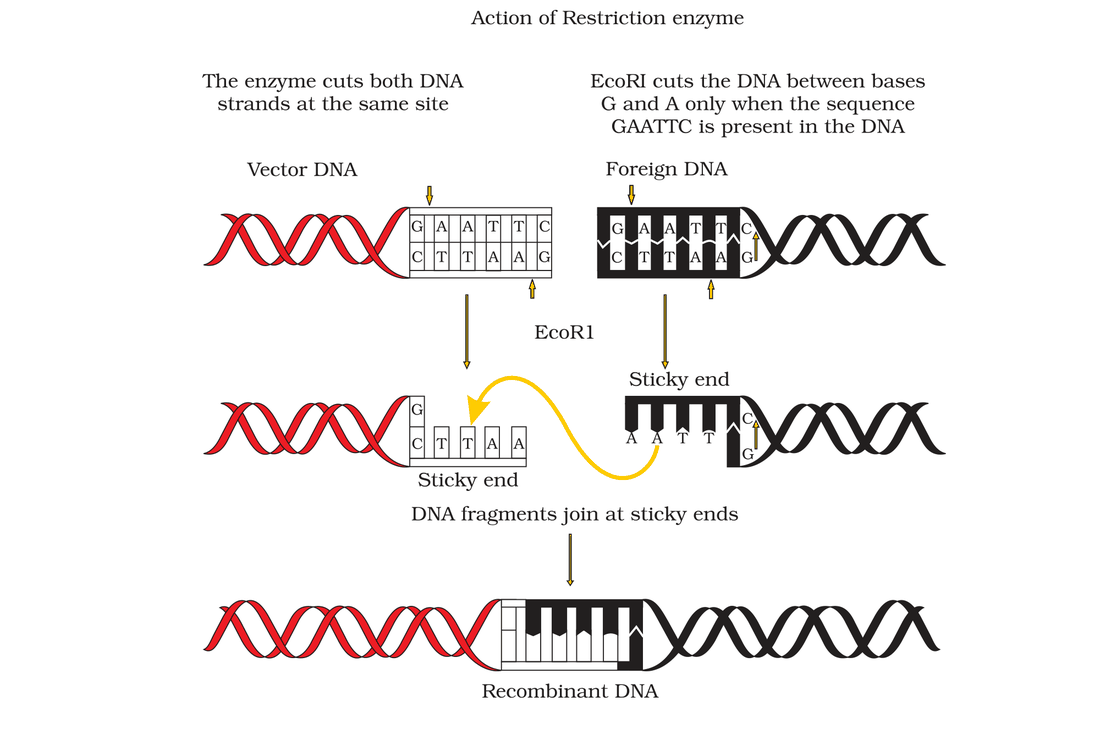
Figure 9.1 Steps in formation of recombinant DNA by action of restriction endonuclease enzyme – EcoRI