Match List-I with List-II.
| LIST-I (Social Movements) | LIST-II (Issues) | ||
| (A) | Chipko Movement | (I) | Agrarian |
| (B) | Trade Union Movement | (II) | Poverty |
| (C) | Naxal Movement | (III) | Ecological |
| (D) | Anti-price Rise Movement | (IV) | Industrial Worker |
Choose the correct answer from the options given below:
Answer & explanation
Correct answer: option 1
The correct answer is Option (1) → (A)-(III), (B)-(IV), (C)-(I), (D)-(II)
(A) Chipko Movement — this matches (III) Ecological. The Chipko movement is the example of ecological movements, raised against the unchecked use of natural resources such as forests.
(B) Trade Union Movement — this matches (IV) Industrial Worker. Trade unions are the organisations of workers in factories and industry; the workers’ movement grew with factory production in India.
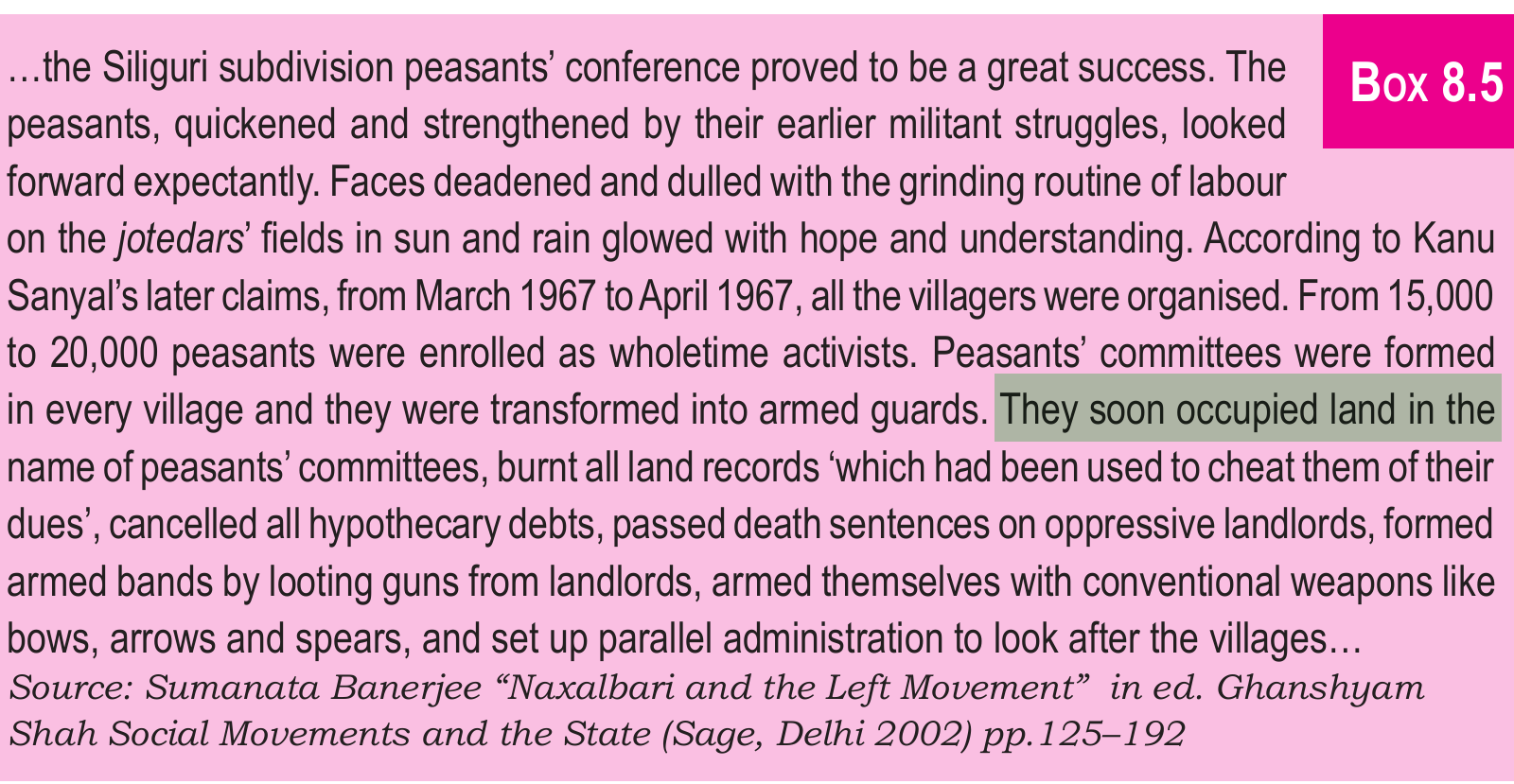
(C) Naxal Movement — this matches (I) Agrarian. The Naxalite struggle belongs to the peasant movements or agrarian struggles. In the Naxalbari rising of 1967, peasants’ committees occupied land, burnt land records and moved against oppressive landlords.
(D) Anti-price Rise Movement — this matches (II) Poverty. The Anti Price Rise Movement of Bombay and Gujarat in the late 1960s was part of a new wave of political action that rose in the face of widespread unemployment, ecological degradation and rampant poverty.
Note: The box on the women’s movement that names the Anti Price Rise Movement (Box 8.13 of the chapter ‘Social Movements’) was there in the pre-rationalised NCERT, which NTA followed in 2023. It has been deleted from the NCERT book (2025-26), though the chapter is still there.
NCERT (2025-26): “8.4 Ecological Movements … Along with this issue of social inequality (villagers versus a government that represented commercial, capitalist interests), the Chipko Movement also raised the issue of ecological sustainability. Cutting down natural forests was a form of environmental destruction that had resulted in devastating floods and landslides in the region.…” “Workers’ Movements … Textile workers in Ahmedabad struck work for increase in wages by 50 per cent (Bhowmick 2004). The first trade union was established in April 1918 in Madras by B.P. Wadia, a social worker and member of the Theosophical Society. During the same year, Mahatma Gandhi founded the Textile Labour Association (TLA). In 1920, the All India Trade Union Congress (AITUC) was formed in Bombay.…”
Box 8.5, in the section ‘Peasant Movements’
Box 8.13 (NCERT Pre-rationalised) |