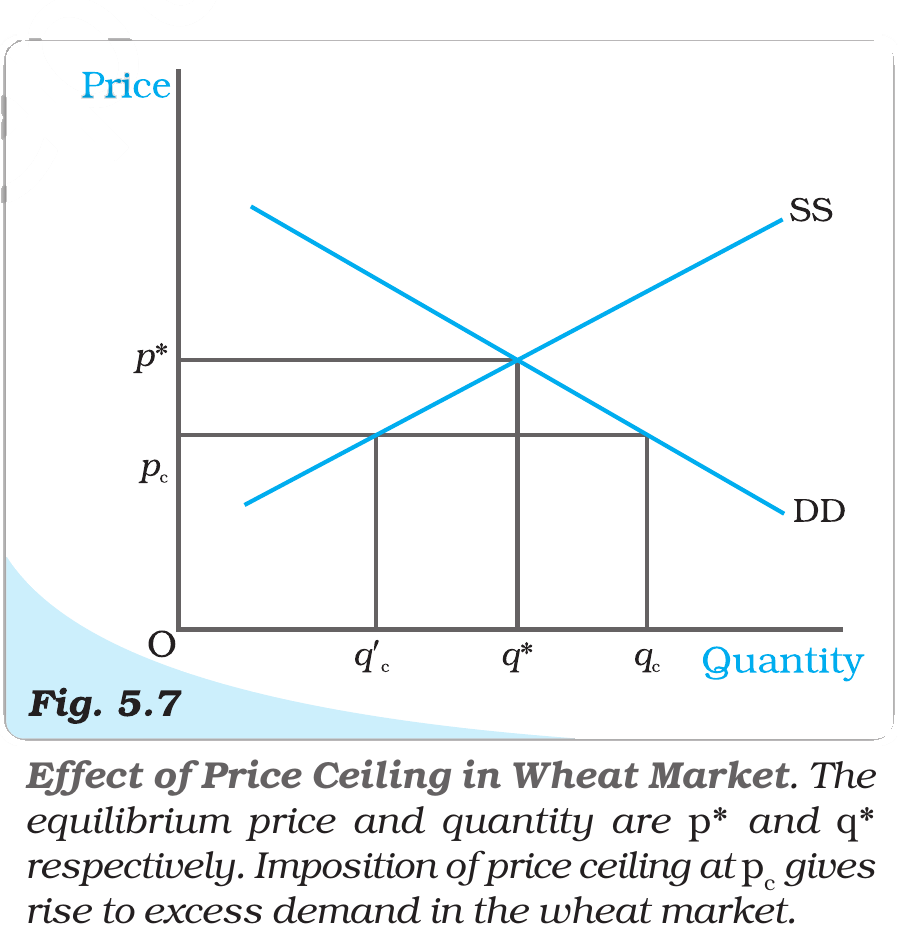
In the perfect competition, the government regulation on goods which results in the creation of a black market is called ?
Answer & explanation
Correct answer: option 1
The correct answer is Option (1) → Price Ceiling.
To keep an essential good such as wheat, rice or kerosene within people’s reach, the government may fix an upper limit on its price, below the equilibrium price. This limit is a price ceiling. At the low price buyers want more than sellers offer, so there is excess demand.
The government then rations the good through fair price shops, but not all consumers get as much as they want, and some are willing to pay a higher price for more. Selling to them at that price, outside the law, is how the black market comes up.
Why the other options are incorrect
Option (2) Price Floor. — Incorrect. A price floor is a minimum price set above the equilibrium, as with minimum support prices for farm goods. It creates excess supply, a surplus, not excess demand, so it does not give rise to a black market.
Option (3) Free Entry and Exit. — Incorrect. Free entry and exit is a feature of perfect competition, not a government regulation. It brings the price to the minimum of average cost and creates no shortage.
Option (4) Fixed Price. — Incorrect. A fixed price does not by itself cause a shortage. Only a maximum price set below the equilibrium does, and that is a price ceiling.
NCERT (2025-26): “5.2.1 Price Ceiling … It is not very uncommon to come across instances where government fixes a maximum allowable price for certain goods. The government-imposed upper limit on the price of a good or service is called price ceiling. Price ceiling is generally imposed on necessary items like wheat, rice, kerosene, sugar and it is fixed below the market-determined price since at the market-determined price some section of the population will not be able to afford these goods.… In general, price ceiling accompanied by rationing of the goods may have the following adverse consequences on the consumers: (a) Each consumer has to stand in long queues to buy the good from ration shops. (b) Since all consumers will not be satisfied by the quantity of the goods that they get from the fair price shop, some of them will be willing to pay higher price for it. This may result in the creation of black market.…”
|