Let \(A=\begin{bmatrix}3 & -1\\ 2 & 4\end{bmatrix}\), then adjoint (A) is:
Answer & explanation
Correct answer: option 4
The correct answer is Option (4) → \(\begin{bmatrix}4 & 1\\ -2 & 3\end{bmatrix}\)
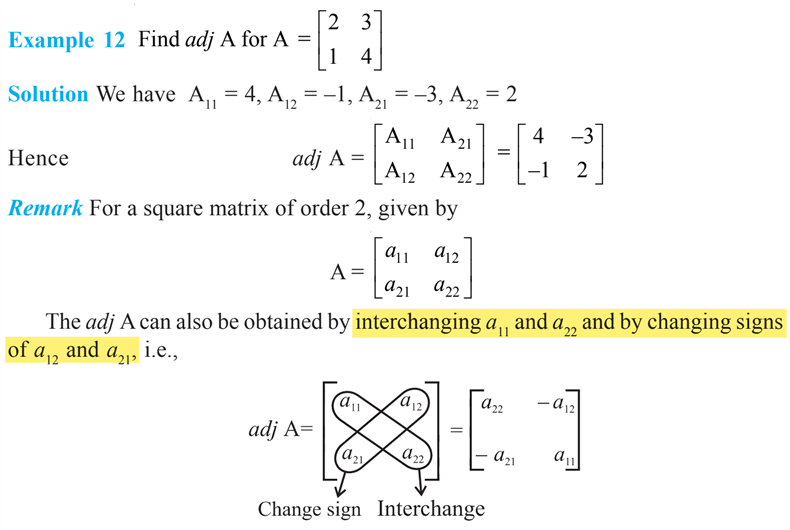
The adjoint is the transpose of the matrix of cofactors. The cofactors of A are
\(A_{11} = 4,\quad A_{12} = -2\)
\(A_{21} = -(-1) = 1,\quad A_{22} = 3\)
So
\( \mathrm{adj}\,A = \begin{bmatrix}A_{11} & A_{21}\\ A_{12} & A_{22}\end{bmatrix} = \begin{bmatrix}4 & 1\\ -2 & 3\end{bmatrix} \)
This is the 2 × 2 rule: swap the diagonal entries 3 and 4, and change the signs of the other two entries.
NCERT (2026-27 edition):
Adjoint of a Matrix