
CUETMOCK
  • Pricing
  • Mentors
Log inStart freeStart free mocks→

First test, then trust

Try a free CUET mock test.

Join 5,00,000+ students who rehearsed exam day on the exact NTA screen before sitting CUET. On the web and on Android.

Start free mocks →Get the Android app
CUETMOCK

India's #1 CUET Mock Test Platform. Original NCERT-based questions on the exact NTA exam screen — trusted by 5,00,000+ students since CUET 2022.

Get it onGoogle PlayScan to download the CUETMOCK app

Mock tests

  • CUET mock test series
  • Browse all papers
  • Commerce mocks
  • Humanities (Arts) mocks
  • Science mocks
  • Languages & GAT mocks
  • Free practice questions
  • Pricing

Resources

  • CUET exam guide
  • CUET syllabus
  • Universities accepting CUET
  • Expert blogs
  • News & notifications
  • Webinars & counselling
  • CUET score calculator
  • How we estimate your rank
  • FAQs

Company

  • About us
  • Our leadership & team
  • Our toppers
  • Mentors
  • For schools
  • Contact us
  • Terms
  • Privacy
  • Refund policy

Talk to us

+91 7696 6630 56info@cuetmock.comWhatsApp us

Our other platforms

  • JEE Mock — For IIT-JEE aspirants
  • NEET Mock — For NEET aspirants

Newsletter

Exam updates, study material and offers — no spam.

© 2026 NYC Ventures Pvt. Ltd.

701-702, Royal Business Park, Zirakpur, Punjab - 140603

  • Terms of use
  • Privacy policy
  • Refund policy
  • Contact us

iCUETMOCK is an independent preparation platform, not affiliated with the National Testing Agency (NTA). Always check exam details on the official NTA website.

  • Home
  • Mock tests
  • CUET guide
  • Pricing
  • Log in
Home/Practice questions/Maths. Section B1
Maths. Section B1Linear Programming

The feasible region of the linear programming problem is represented…

The feasible region of the linear programming problem is represented below:
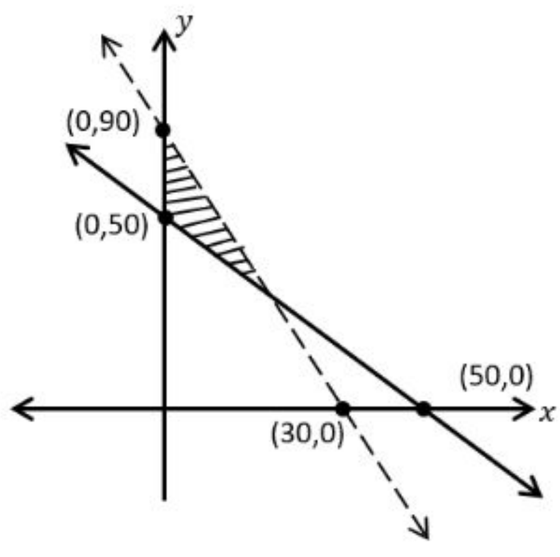
Feasible region of the LPP

The constraints of this LPP are

Answer & explanation+

Correct answer: option 4

The correct answer is Option (4) → \(x + y \ge 50, 3x + y \lt 90, x, y \ge 0\)

Note: The given answer is as per the official NTA Answer Key. However, Option (3) could also be a possible answer, as explained below.

The boundary lines pass through the marked points:

    Through (0, 50) and (50, 0): \(x + y = 50\) (drawn solid)
    Through (0, 90) and (30, 0): \(3x + y = 90\) (drawn dashed)

The shaded region lies in the first quadrant, between (0, 50) and (0, 90) on the y-axis. Testing the origin, which is not in the region:

    \(x + y = 0\), which is less than 50. The region is on the other side, so \(x + y \ge 50\).
    \(3x + y = 0\), which is less than 90. The region is on the same side, so \(3x + y\) is below 90.

The only question is whether the points of the line \(3x + y = 90\) belong to the region. In a graph, a dashed boundary usually marks a line that is not part of the region (a strict inequality). In linear programming, however, constraints are normally written with \(\le\) or \(\ge\), so the boundary lines are part of the feasible region.

Option (1) \(x + y \ge 50, 3x + y \ge 90, x, y \ge 0\) — Incorrect. \(3x + y \ge 90\) is the side of the dashed line away from the origin, but the shaded region is on the origin’s side.

Option (2) \(x + y \lt 50, 3x + y \le 90, x, y \ge 0\) — Incorrect. \(x + y \lt 50\) is the side of the solid line containing the origin, but the shaded region is on the other side.

Option (3) \(x + y \ge 50, 3x + y \le 90, x, y \ge 0\) — Should also be correct, though not the answer given by NTA. It describes the shaded region with the usual non-strict LPP constraints, reading the dashed line only as a boundary of the region. It differs from Option (4) only in whether the points of \(3x + y = 90\) are included.

Option (4) \(x + y \ge 50, 3x + y \lt 90, x, y \ge 0\) — Correct. The solid line \(x + y = 50\) belongs to the region, so the first constraint has \(\ge\); the dashed line \(3x + y = 90\) does not, so the second constraint is strict.

Advertisement

Practise more on Linear Programming

Chapter-wise mocks on the real NTA exam screen, with solutions and your rank. Your first mocks are free.

Start free mocks →

Advertisement

Next questions

  1. Differential coefficient of log_e≤ft[log_e≤ft(log_e x^5)] with respect to x is:Maths. Section B1 · Continuity and Differentiability
  2. Which type of plan is a combination of objectives, policies, procedures, rules, etc.?Business Studies · Planning
  3. Which of the following is a mining town ?Geography · India-People and Economy: Human Settlements
  4. An undifferentiated layer, _____, is present in between the ectoderm and the endoderm.General Aptitude Test · General Knowledge
  5. Sentences of a paragraph are given below in jumbled order. Arrange the sentences in the correct order to form a meaningful and coherent par…English · Arrange in Meaningful Sequence
  6. A charge Q is distributed over two concentric hollow spheres of radii r and R (R > r) such that the surface densities are equal. Find the p…Physics · Electrostatic Potential and Capacitance
  7. Assertion (A): A common remedy for breach of contract is awarding damages to the affected party. Reasoning (R):Monetary compensation given…Legal Studies · Topics of Law
  8. HecticEnglish · Synonyms
  9. A company issued 40,000 preference shares of ₹100 per share at par payable as under: On Application: 20% On Allotment: 40% On First & Final…Accountancy Part A · Accounting for Shares
  10. Match List – I with List – II. List - I List - II (A) Loss on Sale of Sinking Fund Investment (I) Capital to be called up on winding up of…Accountancy Part B · Financial Statements of a Company