
CUETMOCK
  • Pricing
  • Mentors
Log inStart freeStart free mocks→

First test, then trust

Try a free CUET mock test.

Join 5,00,000+ students who rehearsed exam day on the exact NTA screen before sitting CUET. On the web and on Android.

Start free mocks →Get the Android app
CUETMOCK

India's #1 CUET Mock Test Platform. Original NCERT-based questions on the exact NTA exam screen — trusted by 5,00,000+ students since CUET 2022.

Get it onGoogle PlayScan to download the CUETMOCK app

Mock tests

  • CUET mock test series
  • Commerce mocks
  • Humanities (Arts) mocks
  • Science mocks
  • Languages & GAT mocks
  • Free practice questions
  • Pricing

Resources

  • CUET exam guide
  • CUET syllabus
  • Universities accepting CUET
  • Expert blogs
  • News & notifications
  • Webinars & counselling
  • CUET score calculator
  • How we estimate your rank
  • FAQs

Company

  • About us
  • Our leadership & team
  • Our toppers
  • Mentors
  • For schools
  • Contact us
  • Terms
  • Privacy
  • Refund policy

Talk to us

+91 7696 6630 56info@cuetmock.comWhatsApp us

Our other platforms

  • JEE Mock — For IIT-JEE aspirants
  • NEET Mock — For NEET aspirants

Newsletter

Exam updates, study material and offers — no spam.

© 2026 NYC Ventures Pvt. Ltd.

701-702, Royal Business Park, Zirakpur, Punjab - 140603

  • Terms of use
  • Privacy policy
  • Refund policy
  • Contact us

iCUETMOCK is an independent preparation platform, not affiliated with the National Testing Agency (NTA). Always check exam details on the official NTA website.

  • Home
  • Mock tests
  • CUET guide
  • Pricing
  • Log in
Home/Practice questions/Chemistry
ChemistryPhysical: Solid State

Arrange the following solids in the decreasing order of their magneti…

Arrange the following solids in the decreasing order of their magnetic strength in the presence of external magnetic field.

A. NaCl
B. CrO2
C. MnO
D. Fe3O4

Answer & explanation+

Correct answer: option 3

The correct answer is Option (3) → B > D > C > A

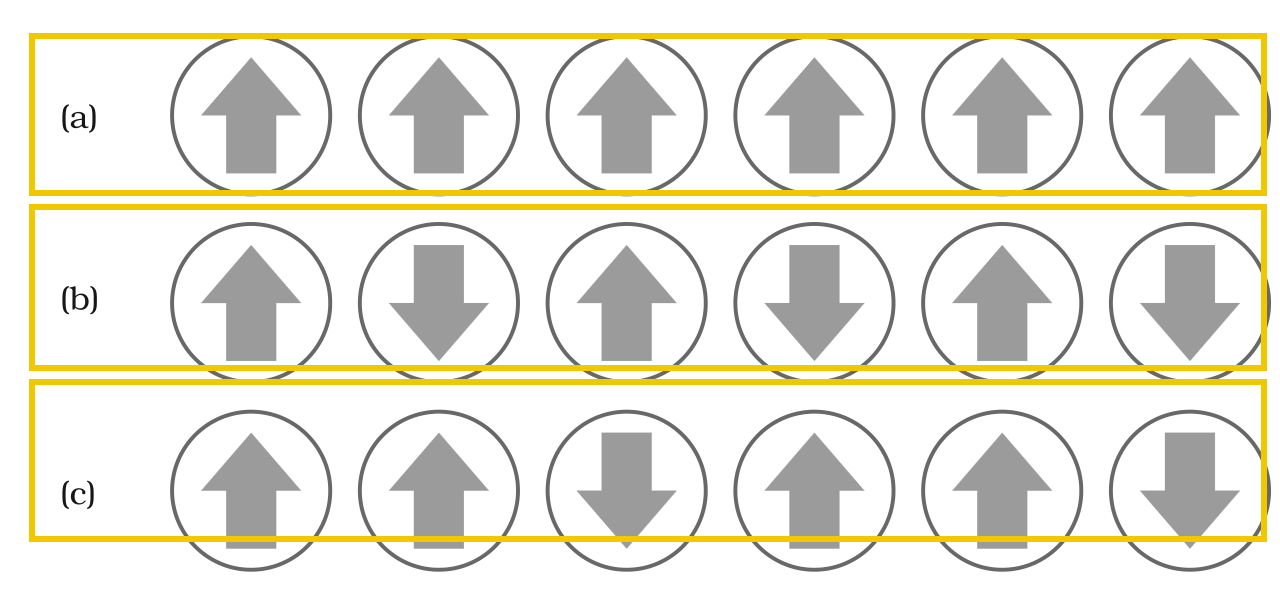
Solids differ in how strongly a magnetic field attracts them: ferromagnetic solids are attracted very strongly, ferrimagnetic solids less strongly (their domain moments cancel only in part), antiferromagnetic solids have no net moment because their domain moments cancel fully, and diamagnetic solids are weakly repelled.

  • (B) \( \ce{CrO2} \) — first. It is ferromagnetic, attracted very strongly and can be permanently magnetised.

  • (D) \( \ce{Fe3O4} \) — second. Magnetite is ferrimagnetic: domains point both ways in unequal numbers, so a net moment remains, but it is weaker than in a ferromagnetic solid.

  • (C) MnO — third. It is antiferromagnetic: equal numbers of opposite domains cancel, so it is hardly attracted.

  • (A) NaCl — last. All its electrons are paired, so it is diamagnetic and is weakly repelled by the field.

Note: This question is from the pre-rationalised NCERT book (2022-23). The topic is not there in the latest NCERT book (2026-27), and it is also out of the CUET 2026 syllabus.

NCERT (Pre-rationalised edition, 2022-23):
Magnetic Properties – “… (ii) Diamagnetism: Diamagnetic substances are weakly repelled by a magnetic field. H2O, NaCl and C6H6 are some examples of such substances. They are weakly magnetised in a magnetic field in opposite direction. Diamagnetism is shown by those substances in which all the electrons are paired and there are no unpaired electrons. Pairing of electrons cancels their magnetic moments and they lose their magnetic character.
(iii) Ferromagnetism: A few substances like iron, cobalt, nickel, gadolinium and CrO2 are attracted very strongly by a magnetic field. Such substances are called ferromagnetic substances. Besides strong attractions, these substances can be permanently magnetised.
(iv) Antiferromagnetism: Substances like MnO showing antiferromagnetism have domain structure similar to ferromagnetic substance, but their domains are oppositely oriented and cancel out each other’s magnetic moment ….
(v) Ferrimagnetism: Ferrimagnetism is observed when the magnetic moments of the domains in the substance are aligned in parallel and anti-parallel directions in unequal numbers …. They are weakly attracted by magnetic field as compared to ferromagnetic substances. Fe3O4 (magnetite) and ferrites like MgFe2O4 and ZnFe2O4 are examples of such substances. These substances also lose ferrimagnetism on heating and become paramagnetic.”
Textbook figure

Advertisement

Practise more on Physical: Solid State

Chapter-wise mocks on the real NTA exam screen, with solutions and your rank. Your first mocks are free.

Start free mocks →

Advertisement

Next questions

  1. सूची-I को सूची-II से सुमेलित कीजिए:सूची-I (कवि)सूची-II (काव्यधारा)(A). दादू दयाल(I). ज्ञानाश्रयी शाखा(B). मीराबाई(II). प्रेमाश्रयी शाखा(C).…Hindi · हिंदी साहित्य (रचना, रचनाकार और विधाएँ)
  2. 'चारु चन्द्र की चंचल किरणें' वाक्य में कौन-सा अलंकार है?Hindi · Alankar
  3. Historians of religion often classify Bhakti traditions into two broad categories, which are:History · Medieval India: Bhakti Sufi Traditions
  4. Select the combination of letters that when sequentially placed in the blanks of the given series will complete the series. _ _ c f b _ c _…General Aptitude Test · General Ability
  5. Which one of the following ligands forms a chelate?Chemistry · Inorganic: Coordination Compounds
  6. If cos 6θ=sin 3θ , then the value of θ is:General Aptitude Test · Quantitative Reasoning
  7. What is the 'eighth month' of the Hijri calendar?History · Medieval India: Kings and Chronicles
  8. Given below are some statements. Read them carefully and choose the correct statement (s) from the given options. Statement 1: During 1952-…Economics · Indian Economic Development: Human Capital Formation in India
  9. Match List-I with List-II ( -2 lt x lt 2 , C is a constant of integration) List-IList-II (A) ∫displaystyledx/(4-x^2) (I) -log|2-x|+C (B) ∫d…Applied Maths. Section A · Indefinite Integration
  10. Assertion (A): Menstrual cycle starts only after attaining sexual maturation (puberty). Reason (R): The first menstruation begins at pubert…Biology · Human Reproduction