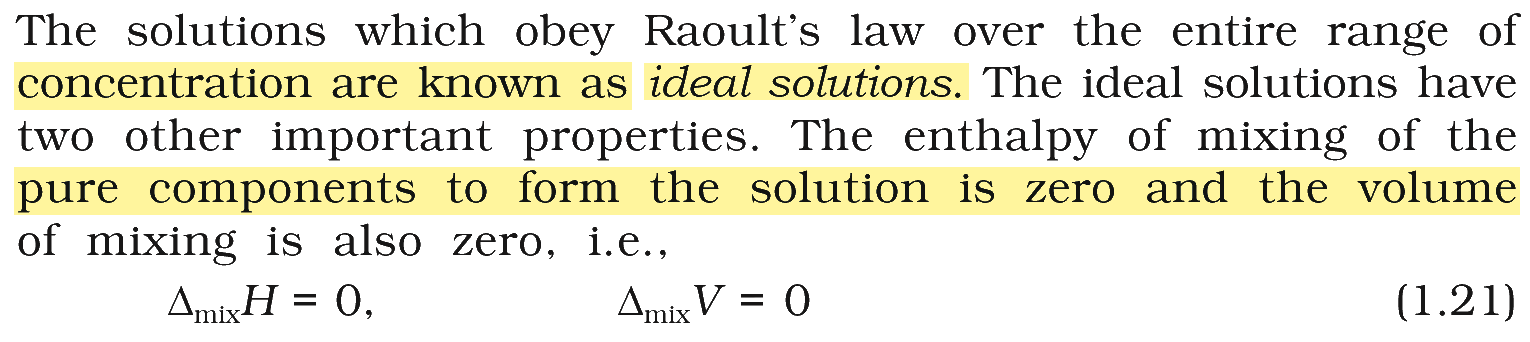
The conditions for ideal solutions are:
(A) Change in enthalpy of mixing is zero.
(B) Change in entropy of mixing is zero.
(C) Change in volume of mixing is zero.
(D) Internal energy change of mixing is zero.
Choose the correct answer from the options given below:
Answer & explanation
Correct answer: option 1
The correct answer is Option (1) → (A), (C) and (D) only
An ideal solution obeys Raoult’s law over the entire range of concentration. This happens when the A–B interactions are nearly the same as the A–A and B–B interactions, so mixing changes neither the energy nor the space the molecules occupy:
\( \displaystyle \Delta_{mix}H=0 \quad \quad \Delta_{mix}V=0 \)
Since no heat is absorbed or released and no volume change occurs, the internal energy of mixing is also zero:
\( \displaystyle \Delta_{mix}U=\Delta_{mix}H-p\,\Delta_{mix}V=0-0=0 \)
Mixing, however, always increases the randomness of the system, so the entropy of mixing is positive even for an ideal solution. This positive ΔmixS is what makes mixing spontaneous.
(A) Change in enthalpy of mixing is zero. — Correct. No heat is absorbed or evolved when the components are mixed.
(B) Change in entropy of mixing is zero. — Incorrect. The molecules become more randomly distributed on mixing, so ΔmixS > 0.
(C) Change in volume of mixing is zero. — Correct. The volume of the solution equals the sum of the volumes of the components.
(D) Internal energy change of mixing is zero. — Correct. It follows from ΔmixH = 0 and ΔmixV = 0, as shown above.
NCERT (2026-27 edition):
Ideal Solutions – …