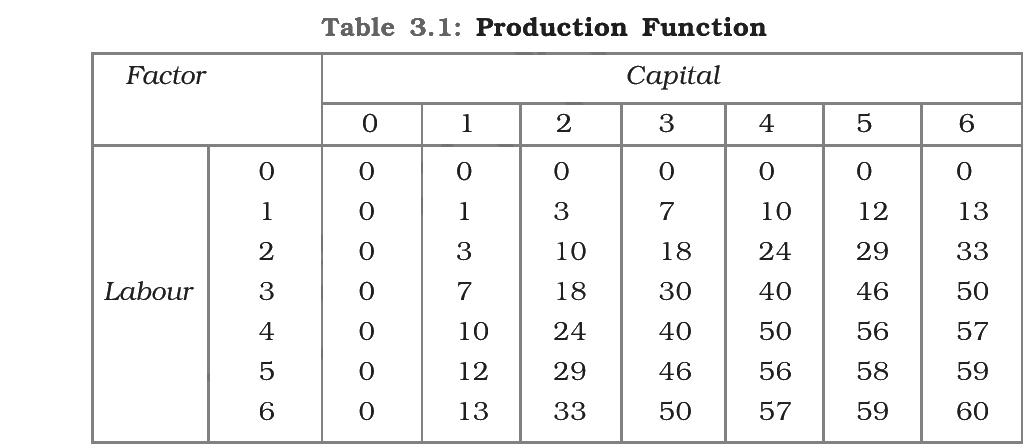
Study the following production function (output in units):
| Labour (L) / Capital (K) | 0 | 1 | 2 | 3 | 4 | 5 | 6 |
|---|---|---|---|---|---|---|---|
| 0 | 0 | 0 | 0 | 0 | 0 | 0 | 0 |
| 1 | 0 | 1 | 3 | 7 | 10 | 12 | 13 |
| 2 | 0 | 3 | 10 | 18 | 24 | 29 | 33 |
| 3 | 0 | 7 | 18 | 30 | 40 | 46 | 50 |
| 4 | 0 | 10 | 24 | 40 | 50 | 56 | 57 |
| 5 | 0 | 12 | 29 | 46 | 56 | 58 | 59 |
| 6 | 0 | 13 | 33 | 50 | 57 | 59 | 60 |
Match List-I with List-II for this production function:
| List-I | List-II | ||
|---|---|---|---|
| (A) | Capital is zero, labour is 5 units | (I) | Output is 18 units |
| (B) | 3 units of labour with 2 units of capital | (II) | Output rises by 6 units |
| (C) | Labour is raised from 4 to 5 units, capital fixed at 4 units | (III) | Output is 50 units |
| (D) | 6 units of labour with 3 units of capital | (IV) | Output is zero |
Choose the correct answer from the options given below:
Answer & explanation
Correct answer: option 4
The correct answer is Option (4) → (A)-(IV), (B)-(I), (C)-(II), (D)-(III)
In this table both inputs are needed: if either is zero, output is zero. Each other entry is read from its row (labour) and column (capital).
| List-I | List-II | Reason |
|---|---|---|
| (A) Capital is zero, labour is 5 units | (IV) Output is zero | Capital is zero, so no output. |
| (B) 3 units of labour with 2 units of capital | (I) Output is 18 units | Row L = 3, column K = 2 gives 18. |
| (C) Labour is raised from 4 to 5 units, capital fixed at 4 units | (II) Output rises by 6 units | Column K = 4: output rises from 50 to 56, by 6. |
| (D) 6 units of labour with 3 units of capital | (III) Output is 50 units | Row L = 6, column K = 3 gives 50. |
NCERT (2026-27): “3.1 Production Function … In our example, both the inputs are necessary for the production. If any of the inputs becomes zero, there will be no production. With both inputs positive, output will be positive. As we increase the amount of any input, output increases.”
|