Which of the following statements about trading on equity is incorrect?
Answer & explanation
Correct answer: option 4
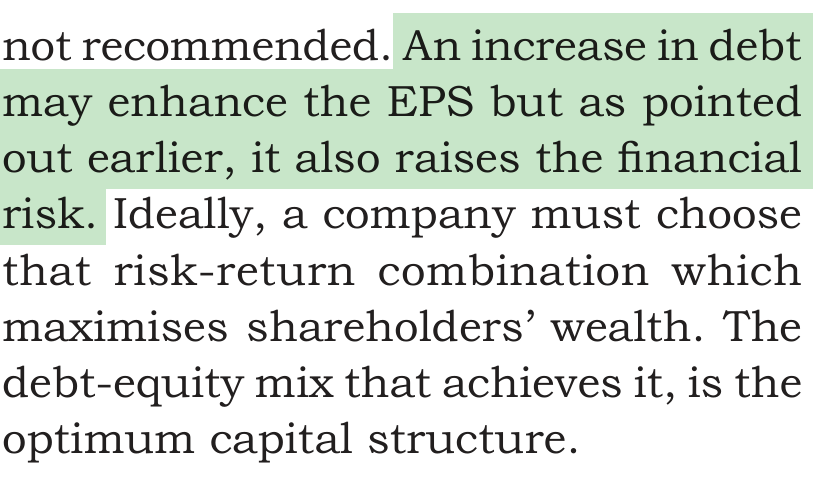
The correct answer is Option (4) → When the RoI is higher than the cost of debt, more debt enhances the EPS and also lowers the financial risk.
Option (1) Trading on equity is the increase in the profit of equity shareholders due to fixed financial charges like interest. — True. This is the definition of trading on equity: using cheaper fixed-cost debt to raise the profit of equity shareholders.
Option (2) When the RoI is less than the cost of debt, trading on equity is unadvisable, as more debt reduces the EPS. — True. When debt costs more than it earns, more debt reduces EPS, so trading on equity should be avoided.
Option (3) Even when the RoI is higher than the cost of debt, a reckless use of trading on equity is not recommended. — True. Even with a high RoI, each extra rupee of debt adds to the financial risk, so debt must be used with care.
Option (4) When the RoI is higher than the cost of debt, more debt enhances the EPS and also lowers the financial risk. — False. The first half is right: more debt can raise EPS. The second half is wrong. Debt brings fixed interest and repayment, so more debt raises the financial risk, even when RoI is high.
NCERT (2026-27 Edition): “EBIT-EPS Analysis … Trading on Equity refers to the increase in profit earned by the equity shareholders due to the presence of fixed financial charges like interest. …”
|