
The maximum value of z = 4x + 3y subject to constraint x + y ≤ 6, x, y ≥ 0 is :
Answer & explanation
Correct answer: option 2
z = 4x + 3y → function
constrains x + y ≤ 6
x, y ≥ 0 (in first quadrant)
plotting first for x + y = 6
| x | 6 | 0 |
| y | 0 | 6 |
Now checking for (0, 0) point for inequality x + y ≤ 6
0 ≤ 6
⇒ Solution lies to side of equation x + y =6
containing (0, 0)
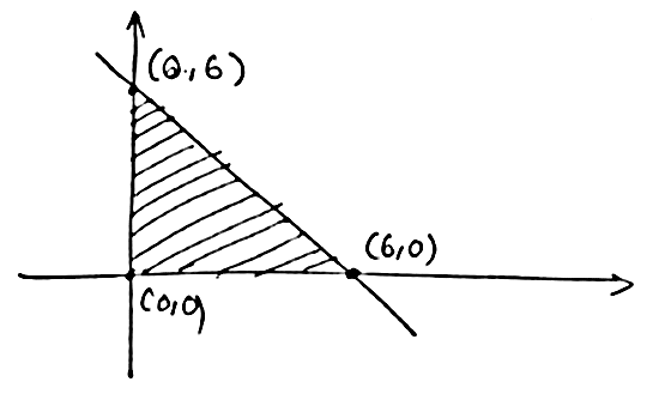
Corner points obtained
(0, 0)
(0, 6)
(6, 0)
function z = 4x + 3y
z(x, y) = 4x + 3y
So z(0, 0) = 0 + 0 = 0
z(0, 6) = 18
z(6, 0) = 24
Max value is at point (6, 0)
which is 24