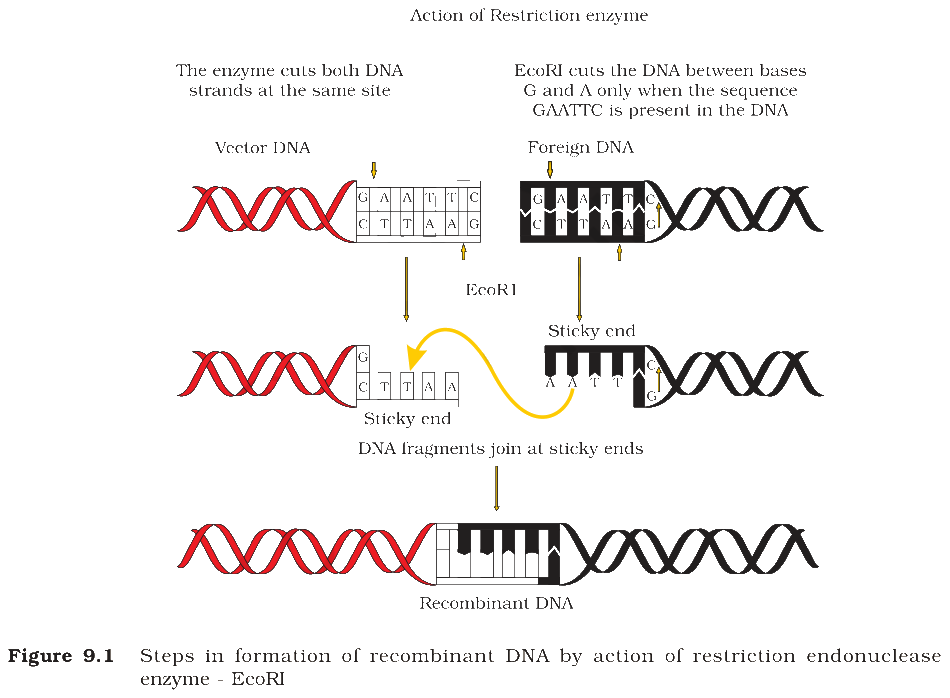
If the sequence of bases on one ‘sticky end’ formed by the action of EcoRI is AATT on a Vector DNA, the sequence of bases on ‘sticky end’ of foreign DNA to which these can join, would be:
Answer & explanation
Correct answer: option 2
The correct answer is Option (2) → TTAA
EcoRI is a restriction enzyme. It recognises the palindrome 5′-GAATTC-3′ and cuts each strand between G and A. This leaves a short single-stranded overhang, 5′-AATT-3′, on each cut end. Such an overhang is called a sticky end. It joins its partner only where the bases pair: A with T, and T with A.
So the bases that pair with AATT, written under it, are:
5′-AATT-3′
3′-TTAA-5′
Option (1) TATA — Incorrect. Placed under AATT, it puts T opposite A, A opposite A and T opposite T. A cannot pair with A, nor T with T, so these ends would not join.
Option (2) TTAA — Correct. Each base is the partner of the base opposite it: T with A, T with A, A with T, A with T. These hydrogen bonds hold the two sticky ends together until DNA ligase seals them.
Option (3) AATT — Incorrect. Placed base for base under AATT, it puts A opposite A and T opposite T, which do not pair.
Option (4) UUAA — Incorrect. Uracil (U) is found in RNA, not in DNA. A DNA sticky end carries thymine.
Note: EcoRI makes the same cut on the vector and on the foreign DNA. So the overhang on the foreign DNA, read in its own 5′→3′ direction, is also AATT (Option (3)). The question asks for the bases on the foreign sticky end that join with AATT, that is the complementary bases. That is why Option (2) TTAA, the answer given by NTA, is the most appropriate answer.
NCERT Extract:
Restriction Enzymes – “… Restriction enzymes cut the strand of DNA a little away from the centre of the palindrome sites, but between the same two bases on the opposite strands. This leaves single stranded portions at the ends. There are overhanging stretches called sticky ends on each strand (Figure 9.1). These are named so because they form hydrogen bonds with their complementary cut counterparts. This stickiness of the ends facilitates the action of the enzyme DNA ligase.”