
A man, $2 \text{ m}$ tall, walks at the rate of $1 \frac{2}{3} \text{ m/s}$ towards a street light which is $5 \frac{1}{3} \text{ m}$ above the ground. At what rate is the tip of his shadow moving and at what rate is the length of the shadow changing when he is $3 \frac{1}{3} \text{ m}$ from the base of the light?
Answer & explanation
Correct answer: option 2
The correct answer is Option (2) → Tip: $2\frac{2}{3} \text{ m/s}$, Length: $1 \text{ m/s}$ ##
Let $AB$ be the street light post and $CD$ be the height of man i.e., $CD = 2 \text{ m}$.
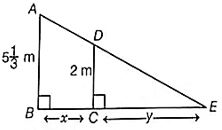
Let $BC = x \text{ m}$, $CE = y \text{ m}$ and $\frac{dx}{dt} = -\frac{5}{3} \text{ m/s}$
From $\Delta ABE$ and $\Delta DCE$, we see that
$\angle ABE = \angle DCE = 90^\circ$
$\angle E \text{ is common}$
So, $\Delta ABE \sim \Delta DCE$ [by AA similarity]
$∴\frac{AB}{DC} = \frac{BE}{CE} \Rightarrow \frac{\frac{16}{3}}{2} = \frac{x + y}{y} \Rightarrow \frac{16}{6} = \frac{x + y}{y}$
$\Rightarrow 16y = 6x + 6y \Rightarrow 10y = 6x \Rightarrow y = \frac{3}{5}x$
On differentiating both sides w.r.t. $t$, we get
$\frac{dy}{dt} = \frac{3}{5} \frac{dx}{dt} = \frac{3}{5} \left(-1\frac{2}{3}\right)$
[since, man is moving towards the light post]
$= \frac{3}{5} \left(\frac{-5}{3}\right) = -1 \text{ m/s}$
Let $z = x + y$.
Now, on differentiating both sides w.r.t. $t$, we get
$\frac{dz}{dt} = \frac{dx}{dt} + \frac{dy}{dt} = -\left(\frac{5}{3} + 1\right) = -\frac{8}{3} = -2\frac{2}{3} \text{ m/s}$
Hence, the tip of shadow is moving at the rate of $2\frac{2}{3} \text{ m/s}$ towards the light source and length of the shadow is decreasing at the rate of $1 \text{ m/s}$.