
Restriction enzymes belong to a larger class of enzymes called nucleases. These are of two kinds; exonucleases and endonucleases. Exonucleases remove nucleotides from the ends of the DNA whereas, endonucleases make cuts at specific positions within the DNA. Each restriction endonuclease functions by ‘inspecting’ the length of a DNA sequence. Once it finds its specific recognition sequence, it will bind to the DNA and cut each of the two strands of the double helix at specific points in their sugar -phosphate backbones. Each restriction endonuclease recognises a specific nucleotide sequences in the DNA.
Restriction endonucleases recognise:
Answer & explanation
Correct answer: option 1
The correct answer is Option (1) →Palindromic nucleotide sequences in DNA
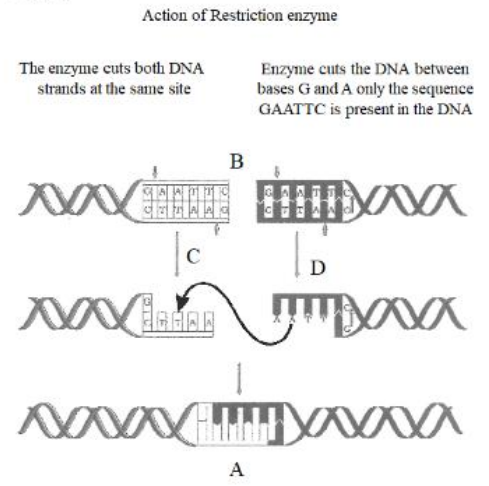
Each restriction endonuclease functions by ‘inspecting’ the length of a DNA sequence. Once it finds its specific recognition sequence, it will bind to the DNA and cut each of the two strands of the double helix at specific points in their sugar -phosphate backbones . Each restriction endonuclease recognises a specific palindromic nucleotide sequences in the DNA.
The palindrome in DNA is a sequence of base pairs that reads same on the two strands when orientation of reading is kept the same.
For example, the following sequences reads the same on the two strands in 5' → 3' direction. This is also true if read in the 3' → 5' direction.
5' —— GAATTC —— 3'
3' —— CTTAAG —— 5
Restriction enzymes cut the strand of DNA a little away from the centre of the palindrome sites, but between the same two bases on the opposite strands. This leaves single stranded portions at the ends. There are overhanging stretches called sticky ends on each strand. These are named so because they form hydrogen bonds with their complementary cut counterparts. This stickiness of the ends facilitates the action of the enzyme DNA ligase.