
Consider the following Linear Programming Problem: Minimise $Z = x + 2y$, Subject to $2x + y \ge 3, x + 2y \ge 6, x, y \ge 0$. Show graphically that the minimum of $Z$ occurs at more than two points.
Answer & explanation
Correct answer: option 3
The correct answer is Option (3) → The minimum value is $Z = 6$ and occurs at every point on the line segment joining $(0, 3)$ and $(6, 0)$. ##
The feasible region determined by the constraints, $2x + y \ge 3, x + 2y \ge 6, x \ge 0, y \ge 0$ is as shown.
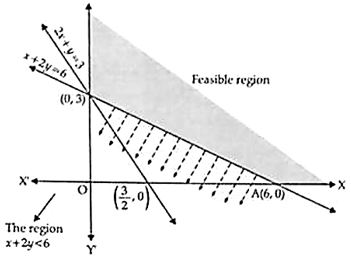
The corner points of the unbounded feasible region are $A(6, 0)$ and $B(0, 3)$.
The values of $Z$ at these corner points are as follows:
|
Corner point |
Value of the objective function Z=x+2y |
|
$A(6, 0)$ |
$6$ |
|
$B(0, 3)$ |
$6$ |
We observe the region $x + 2y < 6$ has no points in common with the unbounded feasible region. Hence the minimum value of $Z = 6$.
It can be seen that the value of $Z$ at points $A$ and $B$ is same. If we take any other point on the line $x + 2y = 6$ such as $(2, 2)$ on line $x + 2y = 6$, then $Z = 6$.
Thus, the minimum value of $Z$ occurs for more than 2 points and is equal to 6.