
Consider the following reaction
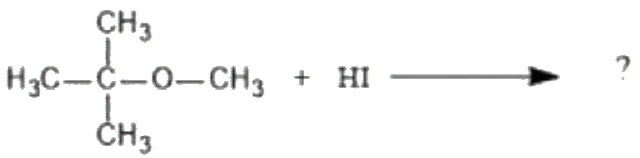
The final products are
Answer & explanation
Correct answer: option 1
The correct answer is Option (1) → (CH3)3C-I + CH3OH
Ethers are cleaved by hot concentrated HI. The ether oxygen is first protonated, and the C–O bond then breaks. Which side ends up as the alkyl iodide depends on the groups on oxygen:
Primary or secondary alkyl groups (SN2): \( \ce{I^{-}} \) attacks the less hindered carbon, so the smaller group becomes the iodide, e.g. \( \ce{CH3-O-C2H5} \) gives \( \ce{CH3I} \) + \( \ce{C2H5OH} \).
One tertiary alkyl group (SN1): the protonated ether breaks to give the stable tertiary carbocation, which combines with \( \ce{I^{-}} \). So the tertiary group becomes the iodide.
Alkyl aryl ethers: the O–aryl bond has partial double bond character, so the products are always a phenol and an alkyl iodide, e.g. anisole gives \( \ce{C6H5OH} \) + \( \ce{CH3I} \).
The given ether is tert-butyl methyl ether (2-methoxy-2-methylpropane). It has a tertiary group, so it reacts by the SN1 path:
\( \displaystyle \ce{(CH3)3C-O-CH3 + H^+ -> (CH3)3C-O^+(H)-CH3} \)
\( \displaystyle \ce{(CH3)3C-O^+(H)-CH3 -> (CH3)3C^+ + CH3OH} \)
\( \displaystyle \ce{(CH3)3C^+ + I^- -> (CH3)3C-I} \)
So the products are (CH3)3C–I + CH3OH.
Why the other options are incorrect
Option (2) (CH3)3C-OH + CH3I — Incorrect. This is the SN2 pattern (iodide on the smaller methyl group). It would be right if both groups were primary or secondary, but a tertiary carbon reacts through the carbocation.
Option (3) (CH3)3C-I+ CH3I — Incorrect. Two iodides form only when a large excess of HI converts the methanol further into \( \ce{CH3I} \); one mole of HI gives the iodide and the alcohol.
Option (4) (CH3)3C-OH + CH3OH — Incorrect. The iodide ion must end up in one of the products; two alcohols would be the result of hydrolysis, which ethers do not undergo with water.