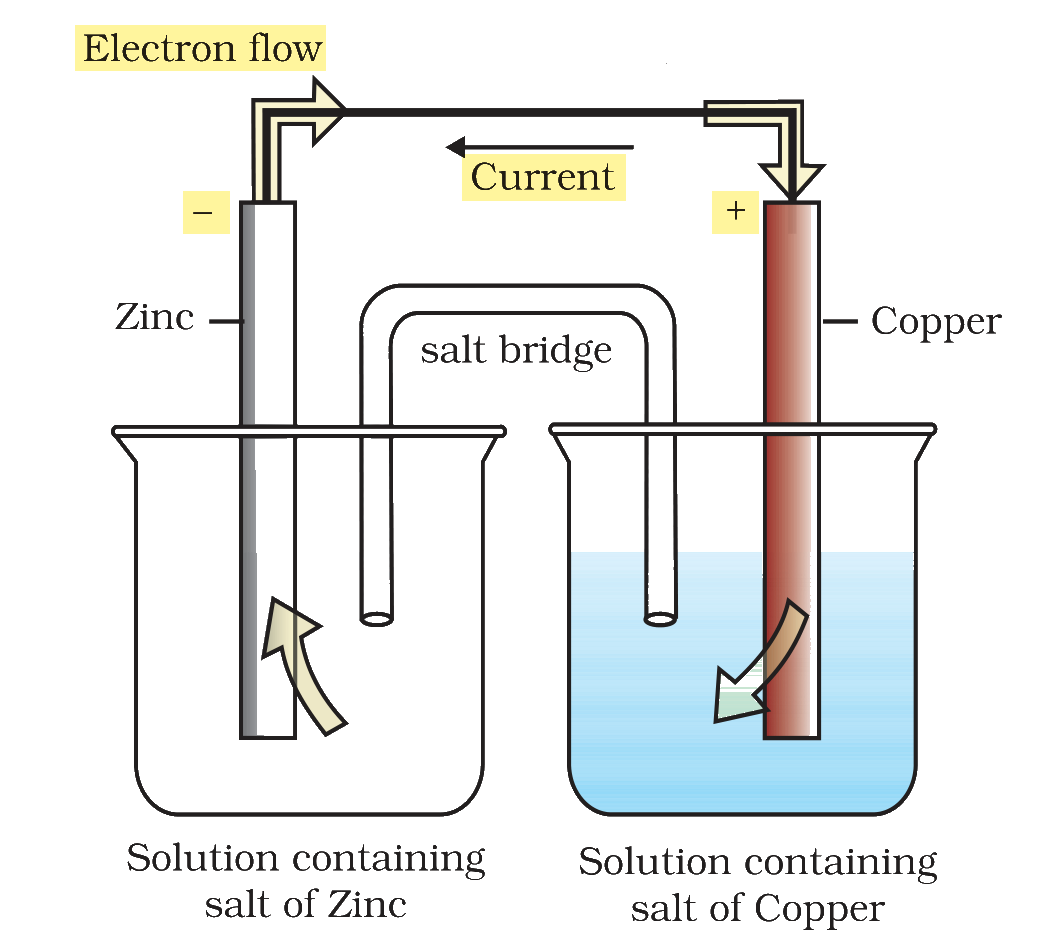
Daniell Cell
Electrochemistry is the study of the production of electricity from energy released during spontaneous chemical reactions and the use of electrical energy to bring about non-spontaneous chemical transformations. The cell below represents Daniell cell which converts the chemical energy liberated during the redox reaction to electrical energy.
Zn(s) + Cu2+(aq) → Zn2+(aq) + Cu(s)
The reaction is a combination of two half-cell reactions, one called the oxidation half-cell and the other called the reduction half-cell. Each half-cell consists of a metallic electrode dipped into an electrolyte. The two half-cells are connected through a metallic wire and switch externally. The electrolyte of the two half cells is connected internally through a salt bridge. At each electrode-electrolyte interface there is a tendency for metal ions from the solution to deposit on the metal electrode, trying to make it positively charged. At the same time, metal atoms of the electrode have a tendency to go into the solution as ions and leave behind the electrons at the electrode, trying to make it negatively charged. A potential difference develops between the electrode and the electrolyte, which is called electrode potential. When the concentrations of all the species involved in a half-cell is unity, then the electrode potential is known as the standard electrode potential.
For a general half-cell; Mn+(aq) + ne− → M(s), the Nernst equation is written as
\( E_{(M^{n+}/M)}=E^{o}_{(M^{n+}/M)}-\frac{RT}{nF}\ln\frac{1}{[M^{n+}]} \)
where \( E^{o}_{(M^{n+}/M)} \) is the standard reduction potential of the half-cell, R is gas constant (8.314 J K−1 mol−1), F is Faraday constant (96487 C mol−1), T is temperature in kelvin and [Mn+] is the concentration of the species, Mn+.
Identify the electrode and the element which undergoes oxidation in the Daniell cell?
Answer & explanation
Correct answer: option 2
The correct answer is Option (2) → Anode, Zinc
In every electrochemical cell, oxidation takes place at the anode and reduction at the cathode. In a galvanic cell, the metal with the lower (more negative) standard reduction potential loses electrons and acts as the anode.
\( \displaystyle E^{o}_{(\ce{Zn^2+}/\ce{Zn})}=-0.76\ \mathrm{V}\quad\quad E^{o}_{(\ce{Cu^2+}/\ce{Cu})}=+0.34\ \mathrm{V} \)
In the Daniell cell, zinc has the lower potential, so zinc atoms are oxidised at the zinc electrode, while \( \ce{Cu^{2+}} \) ions are reduced at the copper electrode:
\( \displaystyle \text{Anode:}\quad \ce{Zn(s) -> Zn^2+(aq) + 2e^-} \)
\( \displaystyle \text{Cathode:}\quad \ce{Cu^2+(aq) + 2e^- -> Cu(s)} \)
So the element that undergoes oxidation is zinc, and the electrode is the anode.
Why the other options are incorrect
Option (1) Anode, Copper — Incorrect. Copper is the cathode of the Daniell cell; copper is not oxidised here.
Option (3) Cathode, Copper — Incorrect. The copper electrode is the cathode, but reduction of \( \ce{Cu^{2+}} \), not oxidation, takes place there.
Option (4) Cathode, Zinc — Incorrect. Zinc is oxidised, but oxidation never takes place at the cathode.
NCERT (2026-27 edition):
Electrochemical Cells – “We had studied the construction and functioning of Daniell cell (Fig. 2.1). This cell converts the chemical energy liberated during the redox reaction
\( \ce{Zn(s) + Cu^2+(aq) -> Zn^2+(aq) + Cu(s)} \qquad (2.1) \)
to electrical energy and has an electrical potential equal to 1.1 V when concentration of Zn2+ and Cu2+ ions is unity (1 mol dm–3). Such a device is called a galvanic or a voltaic cell.”