
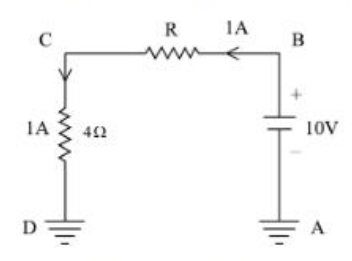
The potential at points B and C, and the value of resistance R are
Answer & explanation
Correct answer: option 3
The correct answer is Option (3) → 10 V, 4 V, 6 \( \Omega \)
The potential of a point is found from a point of known potential by adding the rise across a cell or subtracting the drop \( IR \) across a resistor in the direction of the current. Points A and D are earthed, so \( V_A = V_D = 0 \).
Potential at B. The positive plate of the 10 V cell is joined to B and its negative plate to A, so
\( V_B = V_A + 10\,\mathrm{V} = 10\,\mathrm{V} \)
Potential at C. The current of 1 A flows from C down through the \( 4\,\Omega \) resistor to the earthed point D, so
\( V_C = V_D + I\times4\,\Omega = 0 + 1\times4 = 4\,\mathrm{V} \)
Resistance R. The same 1 A flows from B to C through R, so the potential drop across R is \( V_B - V_C \):
\( \displaystyle R = \frac{V_B - V_C}{I} = \frac{10\,\mathrm{V} - 4\,\mathrm{V}}{1\,\mathrm{A}} = 6\,\Omega \)